Friday, October 28, 2016

Torrent alternate runway exercise preview: Last Republic of Singapore Air Force A-4 Skyhawk to land on a road


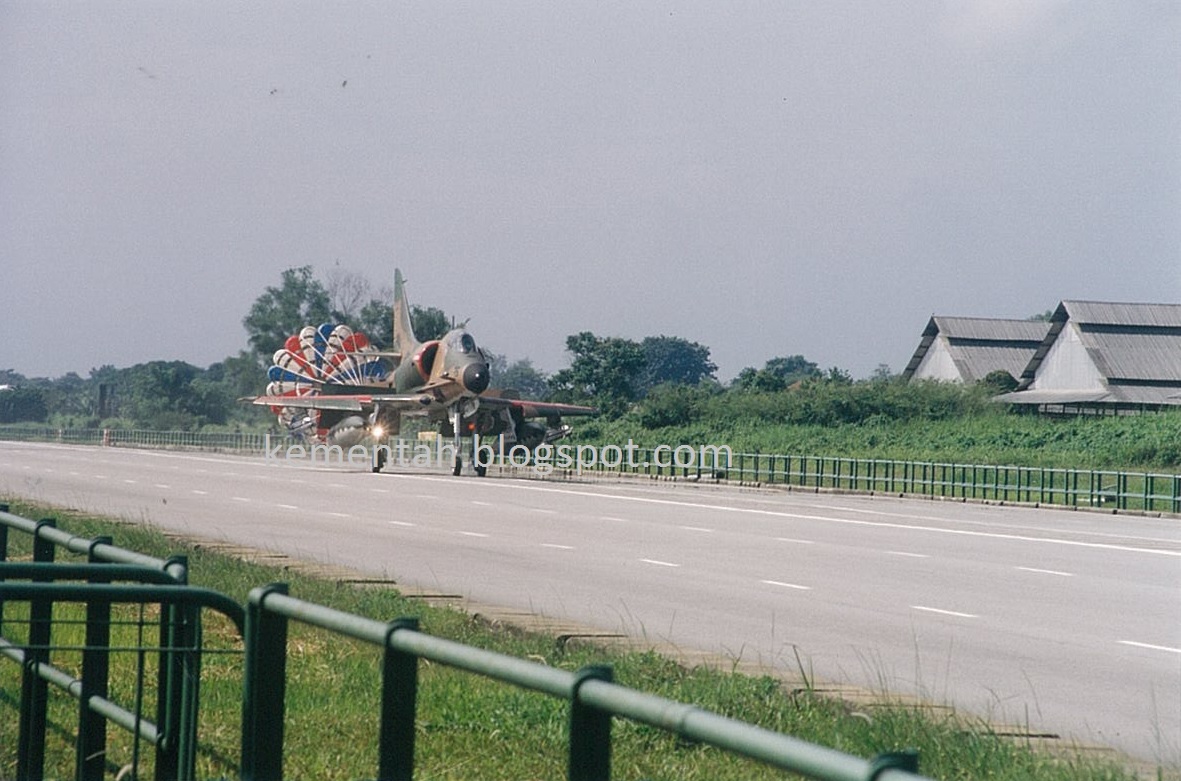
In November 2002, Exercise Torrent V marked the last time Republic of Singapore Air Force (RSAF) Super Skyhawks landed on the 2,500m long alternate runway. The exercise involving converting the 24m wide six-lane carriageway Lim Chu Kang Road to an improvised airstrip in about 48 hours.

RSAF A-4SU Super Skyhawk 926 was the last of two A-4SUs (its wingman was 969) to touch down.

Each Super Skyhawk that flew during Ex Torrent V deployed its drag chute and opened its airbrakes upon landing to slow down the warplane on the alternate runway.

On 1 April 2005, the RSAF's A-4 Skyhawks were officially stood down.

You may also like:
April Fool: Click here


Thursday, October 27, 2016

Exercise Torrent: Republic of Singapore Air Force RSAF Alternate Runway Exercise Airbase Civil Engineering Squadron


Aptly named the FOD Killer, this is a road sweeper designed to suck debris that could cause foreign object damage (FOD) to Republic of Singapore Air Force assets.

The Operations Support Flight (OSF) of 505 Squadron, which is the Airbase Civil Engineering Squadron at Tengah Air Base, operates the single-seat vehicle, known as the FMC Vanguard V7000 FOD Killer.

The FOD Killer doesn't just give large paved areas a good suck. It has a magnetised hood mounted in front of the vehicle that can pick up metal objects like nuts and bolts from runways, taxiways and aircraft aprons.

The use of Lim Chu Kang Road as an alternate runway is made possible by the tireless efforts of personnel from 505 SQN, whose OSF FOD Killers make umpteen trips up and down the 2,500m long road to remove FOD hazards before warplanes are allowed onto the alternate runway.

Wednesday, October 26, 2016

Exercise Torrent: RSAF Alternate Runway Exercise Field Defence Squadron


Force protection troopers from the Field Defence Squadron, Tengah Air Base (FDS TAB) patrol the length of Lim Chu Kang Road before flying activities for Exercise Torrent V commence in November 2002.

The 2,500m long, six-land carriageway (24m wide), designated as an Emergency Runway (ER), was protected by FDS TAB for the duration of the 48-hour long exercise.

Seen on the ER are a V-200 armed with a 20mm Oerlikon cannon and six Mercedes-Benz MB240GDs armed with pintle-mounted 7.62mm GPMGs.

FDS troopers also hone their tactics during war games such as Iron Arrow and the Eagle Challenge, organised for Air Power Generation Command units. The FDS has since been renamed the Force Protection Squadron.

Tuesday, October 25, 2016

Torrent update: Republic of Singapore Air Force RSAF Alternate Runway Exercise


Breaking the speed limit along Lim Chu Kang Road, Republic of Singapore Air Force (RSAF) F-16A Fighting Falcons from 140 Squadron thunder off the six-lane carriageway on full reheat during Exercise Torrent III in 1992.

The F-16As took part in three Torrent war games before the type was supplanted by the more advanced F-16C/Ds from Ex Torrent V onwards.

The pictures below show an F-16A demonstrating the touch-and-go manoeuvre. Note the second F-16A in the landing circuit in the image below.

Monday, October 24, 2016

Exercise Torrent VII 2016: Republic of Singapore Air Force RSAF alternate runway exercise

Cleared for take-off: Every type of frontline RSAF warplane was represented at Exercise Torrent III, held on 1 November 1992. Seen here are A-4SU Super Skyhawks, which accelerated for take-off immediately after making the right-hand turn onto Lim Chu Kang Road after emerging from Tengah Air Base. 


The following essay was published in The Straits Times on 1 December 2008, to mark the successful staging of the Republic of Singapore Air Force (RSAF) Exercise Torrent VI, which tested the Air Force's ability to launch and recover warplanes from an alternate runway.

This essay will be updated this year to reflect upcoming changes in the number and location of runways on mainland Singapore, in time to come.

Do look out for the revised essay and daily updates as we crank up the tempo ahead of Ex Torrent VII. Have witnessed Torrent III, Torrent V and Torrent VI. Will share pictures from these exercises in the run-up to the upcoming war game.


Hit the road, jets
By David Boey
For The Straits Times
1 December 2008

The 20 minutes of air activity at the Republic of Singapore Air Force (RSAF) exercise at Lim Chu Kang Road yesterday ranked as one of the air force’s shortest war games.


Despite its brevity, however, the conversion of a public road into an improvised military airstrip during Exercise Torrent VI provided a vivid demonstration of the degree to which Singapore’s air power resides with the RSAF’s Air Power Generation Command (APGC).


Some 400 personnel from the command took 48 hours to transform the 2,500m long road into a runway. 

Twelve warplanes – representing all of the RSAF’s fighter types in service and one E-2C Hawkeye Airborne Early Warning plane from the RSAF’s Air Combat Command (APGC) – broke the speed limit along Lim Chu Kang Road as they showcased the air force’s little-known capability to launch and recover aircraft using a public road.


Even less known is the fact that the groundwork for Exercise Torrent was laid more than 30 years ago. The capabilities the RSAF demonstrated yesterday can be traced to the Operational Master Plan (OMP) for RSAF air bases that the Ministry of Defence drew up in the mid-1970s. Dr Goh Keng Swee, the architect of the Singapore Armed Forces, was defence minister and Mr Lee Kuan Yew, the prime minister. Singapore’s defence planners recognised even then that attacks against air bases could clip the RSAF’s wings.


The RSAF’s warplane fleet would count for nothing if runways were damaged and its air power grounded. Lack of air cover would, in turn, jeopardise the mobilisation of SAF units during the critical hours of an emergency when large numbers of citizen soldiers reporting at mobilisation centres would present the enemy with a target-rich environment.


The OMP mapped out how the RSAF would plan, develop, test and revise operational concepts for air bases during periods of tension and hostilities. This led to the formation of specialised, non-flying squadrons in the early 1980s. These included squadrons tasked with runway surface repairs, disposal of enemy ordnance such as unexploded bombs or munitions with time delay fuses, as well as the maintenance of essential services such as power, fuel and water. A network of fibre optic cables was buried in hardened conduits to reduce the air force’s reliance on radio communications which can be intercepted and jammed by a technically competent foe.


At the same time, the number of runways available to RSAF warplanes was doubled, from six in the 1980s to 11 today – more if you count narrow taxiways that the fighters can also use. This includes a runway built on Pulau Sudong.


Roads that could be converted into runways were identified and plans were drawn up for the RSAF to practise operating from such improvised runways. Buildings, such as warehouses, that can serve as temporary aircraft hangars were also identified. Complementing such infrastructure were war games that allowed RSAF personnel to think about how they could maximise air power generation from all the runways.


Taking off is a simple enough matter. Far more complex is the safe and orderly launch of combat aircraft in the right sequence, armed with the right weapons and put in the take-off queue according to operational priorities.


With more than 100 combat aircraft in the RSAF’s fleet – not to mention hundreds of weapon, fuel tank and sensor configurations for each aircraft – this was no simple task. The APGC’s tagline, “Air power starts with us”, sums up how the sharp end of the RSAF relies on, and is sustained by, robust air base infrastructure.


The RSAF helicopter fleet has also practised out-of-base operations , deploying and rearming choppers from places such as open fields and golf courses. Only a handful of air forces, including those of Finland, Korea, Sweden, Switzerland and Taiwan, practise such capabilities.


A clear signal of the importance of such capabilities occurred in April 1986, when RSAF fighters soared off a road for the first time. The landmark war game, held when Singapore was recovering from the 1985 economic slump, underlined the nation’s commitment to investing in defence even during tough times.


The RSAF has staged Exercise Torrent six times in the past 22 years. The speed with which the air force has transformed itself into a Third Generation fighting force becomes evident when one considers that the only common elements between the first and latest exercise are these: the road itself and the professionalism of the RSAF’s personnel.


Everything else, from the warplanes used and to the RSAF’s uniforms, has evolved or been upgraded. Even the term Mindef uses to describe Lim Chu Kang Road has changed. It is now called an “alternate runway” as opposed to “emergency runway”, a term which probably connotes that something dire to the aircraft's function may have occurred.


Lim Chu Kang Road is a key element in Singapore’s defence infrastructure. Its absence from databases that purportedly rate military power shows that simply counting soldiers and war machines as a measure of a country's military muscle is inadequate.


Such capabilities inject uncertainty into the calculations of hostile powers that may want to cripple Singapore’s air power. A larger number of runways means the enemy would have more targets to hit. This in turn would call for the enemy to deploy more military assets – be it rocket artillery units or air strikes. And the larger the attack force, the higher would be the chance it will be detected by the SAF’s intelligence network. A larger force would also be more vulnerable to the comprehensive suite of the SAF’s defences.


Combat readiness aside, Singapore also places emphasis on defence diplomacy as a key element in maintaining peace in its neighbourhood. This is why foreign military observers were invited yesterday to see Exercise Torrent VI. Closer to home, defence diplomacy includes overtures to community leaders, who helped residents in the vicinity understand, and appreciate, the RSAF’s mission.

One hopes that no one makes a strategic miscalculation that would force Singapore to deploy its airpower islandwide, because the torrent of air strikes the RSAF can muster will be robust, continuous and devastating.


END

Sunday, October 23, 2016

Republic of Singapore Air Force Exercise Torrent VII


Have been keenly following the Republic of Singapore Air Force (RSAF) alternate runway exercise (renamed from emergency runway exercise), codenamed Torrent, since the first one in 1986.

We're counting down to Exercise Torrent VII. Look out for special reports on this long-running and long-awaited war game.

Check Six!


Tuesday, October 11, 2016

#RedArrowsinSG Red Arrows visit to Singapore postponed to Sat 15 Oct 2016


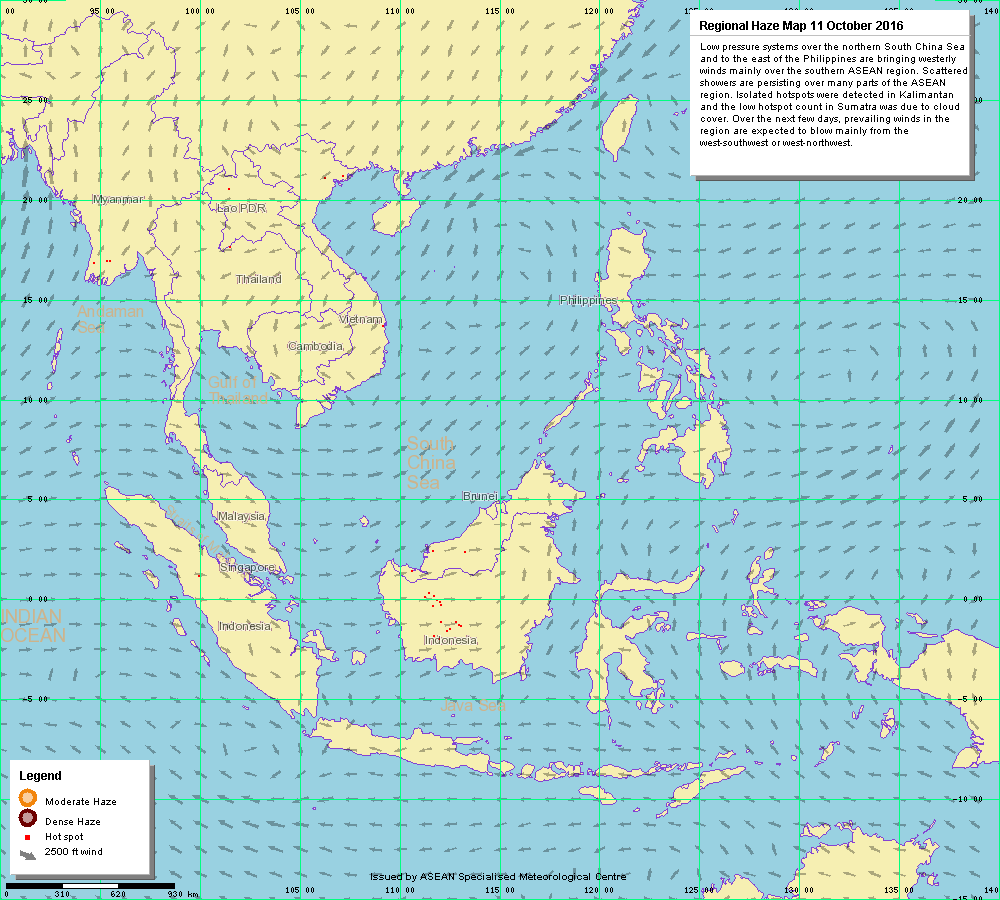
The British High Commission announced this afternoon that the Royal Air Force’s Aerobatic Team or Red Arrows' visit to Singapore that was scheduled for this Thursday (13 October 2016) has been postponed to Saturday, 15 October 2016. 

The rescheduling was caused by an unexpected weather system in the South Asian region, said a British High Commission statement. 

The Red Arrows’ Flypast over the vicinity of Marina Bay, Gardens by the Bay and Sentosa will now take place from around 12.30pm to about 1.00pm this Saturday (15 October 2016).