Tuesday, December 31, 2013

Hello 2014


Before we close shop for the year, I would like to extend to all of you my best wishes for 2014.

To all the servicemen and servicewomen whom I met this year, thank you for patiently taming my curiosity, for taking me into your confidence by sharing more about the work you do and for walking the talk.

It is always a joy being able to see military units from Malaysia and Singapore firsthand and one is aware when watching a military demo that many hands working behind the scenes are often critical to the show's success. Your personal contributions to the demos I have witnessed have always been uppermost on my mind and I thank you deeply for all that you have done, even though we may not have crossed paths directly. The unprecedented number of study visits conducted in 2013 has left me with quiet admiration and a deep sense of respect for the profession of arms - both sides of the Causeway.

To my mentors, thank you for helping me join the dots. Let's just leave it at that. :-)

Am pleased with the level of sensemaking we achieved this year. The "we" includes contributions from blog readers who wrote in with ideas, suggestions and constructive feedback. I appreciate the time and effort each of you took to frame your thoughts and pen your correspondence.

The bar will be lifted even higher in 2014. Count on it.


Monday, December 30, 2013

The defence information ecosystem in Malaysia: A look at Malaysian defence blogs and magazines

Although Malaysia lacks the budget and institutional framework that drives commitment to defence in Singapore, there appears to be no lack of interest that drives defence awareness north of the Causeway.

Whether among the Rakyat at the grassroots level or among its intelligentsia, the deep roots Malaysian society has sunk in the defence and security arena is best seen by these factoids:

* Malaysians author more blogs dedicated to defence matters than Singaporeans, this despite having compulsory National Service (NS) in Singapore since 1967 which has exposed more Singaporeans to military training than Malaysians.

* There are more defence magazines published from the Malaysian capital than in Singapore. Indeed, the region's oldest defence magazine, Asian Defence Journal, was started in Malaysia in 1970.


This state of play is interesting from a media studies point of view and is certainly beneficial to staff officers in Jalan Padang Tembak tasked to cultivate hearts and minds.

Expanded toolkit
The reason is simple: Malaysian defence planners have more tools in their toolkit than their counterparts in Gombak Drive. Ideas, viewpoints, unofficial yet credible impressions that border on plausible denial can therefore be floated using a whole spectrum of communication tools. These range from blogs at the lower end of the spectrum to full-fledged defence magazines at the other end of the scale.

Whether leveraging on the World Wide Web or magazine subscriptions, the audience Malaysia touches is global. Malaysian psywar officers are likely to view the defence media scene on the home front as an asset worth cultivating in peacetime and certainly worth exploiting during a hot-war scenario where an occupier's every misstep or transgression against a captive population would be given maximum, worldwide publicity using every available channel.

It is perhaps during a Period of Tension (POT), that grey area, the awkward phase of interstate relations that is neither business-as-usual and just short of all-out war, that Malaysia's expanded range of options in the defence information sphere will probably make its presence felt. When pitted against another country that is forced to make the first strike, is bound by operational constraints to occupy Malaysian terrain, the narrative that Malaysia can share to the world will likely fall on sympathetic ears. The more media channels, the merrier, as the impact will be keenly felt.

The state of play cannot be examined simply by a census of what Malaysia has and what another society lacks.

It is what the state of play points to - which is the presence of a (apparently) thriving defence ecosystem where points of view can be articulated and debated rigorously - that is all the more valuable than simply having more of one or the other.

Let's now look at their  defence information ecosystem, namely blogs and defence magazines.

Malaysian defence blogs
At first glance, the larger number of defence-themed blogs sustained by the Rakyat vis-à-vis Singapore isn't surprising. One could argue that this is proportionate to the larger population in Malaysia compared to that in the Lion City. True.

Malaysian defence blogs include but are not limited to the following:

A Secure Malaysia. Click here

Malaysian Defence by Marhalim Abas. Click here

Malaysian Flying Herald. Click here

Malaysian Military Power. Click here

We also have the Facebook page by Malaysian defence journalist, Dzirhan Mahadzir (click here) and assorted blogs that touch on defence matters such as OutSyed The Box (click here).

One needs to ponder why defence blogs have a ready audience in Malaysia when Singapore has had 46 years of NS. We also have an armed forces whose full force potential is larger than Malaysia's war machine. With 900,000 Singaporean males having served NS and with the fully mobilised Singapore Armed Forces (SAF) outnumbering the Angkatan Tentera Malaysia (ATM), one could make a convincing and logical case why there ought to be more bloggers on defence matters in Singapore than up north.

Alas, this is not so. And mind you, the blogs listed above are all in English

More than just numbers, the quality of writing on a number of Malaysian blogs is noteworthy. Articles posted on Malaysian Flying Herald, for example, would challenge the viewpoint among some in the Singapore establishment that blogs are run by amateurs who churn out content that pales in comparison when ranked against mainstream media.

If our aversion to defence blogs is a result of NS-induced apathy, then the trend is worrisome.

If the trend is a by-product of officialdom's tight-fisted approach to handling the defence information scene, then aren't we scoring own goals when the system's suspicious attitude towards the inquisitive, the knowledgeable and the passionate ends up alienating the very individuals who could be brand ambassadors for the Ministry of Defence (MINDEF) and the SAF?

If one views the glass as half full, it could also be a result of the proliferation of defence media - albeit government-run - such as Pioneer, Pointer and internal media (Army News, Navy News, Air Force News, RSAF Focus) as well as the many ORD publications that have sustained defence buffs in Singapore with a steady stream of military news and views. But hands up if you think this is so.

Malaysian defence magazines
The defence publication scene in Malaysia is also interesting to analyse.

There exists among some Singaporeans the blinkered view that the Republic is more articulate, more savvy with the English language than the backward, Kampung-style society they enter when one crosses the Causeway.

Nothing could be further from the truth when one assesses the defence magazine market.

Malaysian entrepreneurs have proven they know how to make a buck in the competitive defence publications scene and have outlasted at least three Singaporean magazines that dabbled partly in defence matters in the 1990s.

While there is no denying that higher postage rates and the availability of defence content - much of it free - in cyberspace has challenged the business model for print publications, there are loyal customers in the Federation and beyond who underpin Malaysian defence magazines.

If the  English ones help Padang Tembak address a global audience, those in the vernacular help fortify the Rakyat's faith in the ATM as the defender of the realm.

The editorial slants taken by Malay language publications such as Perajurit when writing about ATM operational taskings such as Ops Daulat, Fajr and Piramid have been nothing short of what MINDEF/SAF would wish local media journalists would bang out on their respective keyboards.

The Malay language articles steer away from jingoism - which can be off-putting - and hit the sweet spot by projecting the ATM as a professional, disciplined, motivated and operationally-ready armed forces even when venturing into intellectual minefields like Ops Daulat.

This is not to say that KEMENTAH has KL's defence magazines eating out of its hand. Far from it. KEMENTAH probably realises the credibility of the editorials is more valuable in serving its defence information needs than having a compliant media. Good for it.

As with the blogs, having precious few defence magazines Singapore can call its own (Defence Review Asia doesn't count as it has Australian shareholders, despite its Singaporean address) is not in itself a source of weakness.

It is also true that when one looks at other benchmarks for cultivating international opinion, our island republic appears to hold an unmatched advantage.

This includes its standing in international fora and the multi-year yet low-profile effort to spawn a new generation of Singapore-friendly foreigners by hosting them for higher studies in Singapore as young adults. It is thought that in time to come, some of these bright young students will rise to positions of authority in their home countries and look upon Singapore with kindly eyes, having spent part of their life here.

It is a noble initiative that should, in theory at least, work in Singapore's favour. But one must recognise this is a long-term effort whose results are difficult to measure and a potential double-edged sword that could haunt Singapore should a bright young student have a sour experience on home ground.

In the meantime, the disparity between the defence information scene in Malaysia and Singapore is likely to stay the way it is.

In peacetime, the image of MINDEF/SAF will not die just because of a single nasty blog post from the Federation or one stinker of an editorial from KL.

But we need to be self-aware of the imbalance and that where we have few, Malaysia has many.

Death by a thousand cuts still results in the same thing.
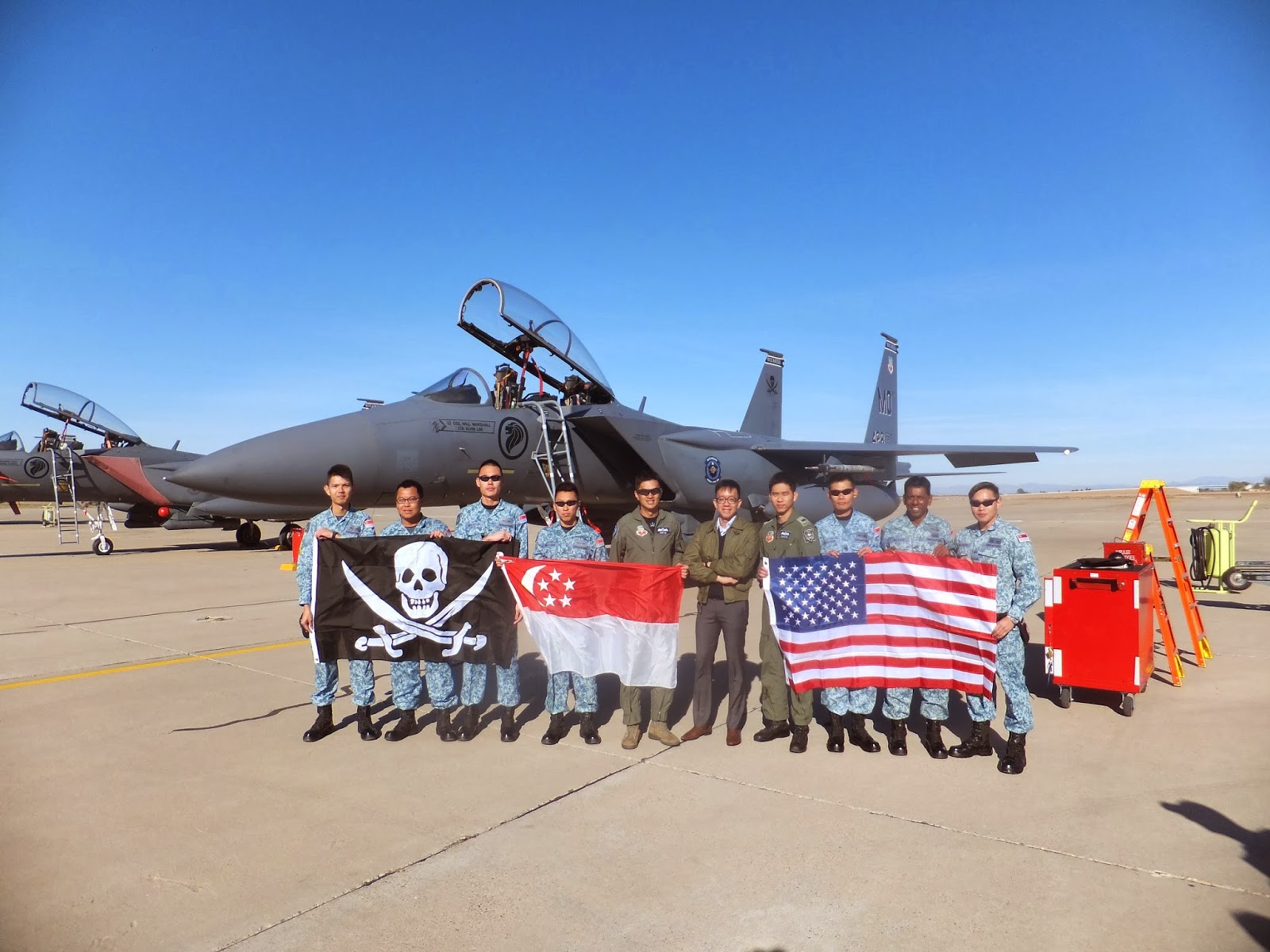
Sunday, December 15, 2013

Downtime in Arizona


What do Singaporeans do when they have free time in the city of Phoenix, Arizona, that takes them away from the Singapore Armed Forces (SAF)' largest and most complex war games involving precision strikes?

A number raid factory outlets to pick up cheap designer brands or launch shopping expeditions of some sort. *yawn* Sorry but am just not the shopping type.

Some go to the Grand Canyon to see the eight wonder of the world.

Or you could drive two hours south to watch A-10 Thunderbolts fly and, while in the vicinity, visit Davis-Monthan Air Force Base.[The suggestion came from a Republic of Singapore Air Force officer who saw my eyes glaze over when the others were planning shopping trips.]


And so, I drove myself two hours south of Phoenix to watch A-10s fly (above) and got a bonus with an unplanned visit to a hardened missile silo.

With no travel partner, it was a solo self-drive that started before sunrise with the GPS lady's voice as company throughout the journey. Engine start was at 0500hrs as I wanted to avoid the traffic jams on Interstate 10 in Phoenix. Most of the run to the south took place in darkness. If as the old saying goes "it is darkest before dawn", this was the setting for the 120+ mile one way trip south to the city of Tuscon where Davis-Monthan AFB is located. This night pre-dawn drive at 55-75mph on the wrong side of a motorway which is largely unlit is new to me.

I leave the radio off throughout and savour the silence. It gives me ample time to run through the many things seen and experienced during XFS'13 and with the PCII team. It has been a memorable week.

Am thankful the car rental guy's advice to go one up and not rent the cheapest wheels was accepted as the tiny low CC Fiat would've had a tough time winding in and out of lanes populated by huge American semis (i.e. prime movers and trailers).

Had no clue about the landscape either side of the interstate. Saw signs for Marana. Flirted with the thought of making a side trip to stalk the RSAF's Peace Vanguard Apache detachment but decided to stick to the plan as Davis-Monthan has been on my to-see list for some time.


Arrive at the Pima Air & Space Museum just before 7am after a non-stop journey. Gates to the museum are wide open so I pop in for a look. Not a soul in sight. High tide. Gift shop toilets are locked. Found a discrete spot out of line-of-sight and security cameras where I water the cacti :-)

Spent time before museum's 9am opening driving round the fenceline of the sprawling air base. Breakfast at a gas station. Ate more than usual as unsure when next meal would be. Had a quarter pounder with cheese and milk and am basically fully fuelled.

The two hours is well spent as there are no dogs here.

A-10 drivers have an early start to the day. Same goes for the C-130s. Breathtaking watching them perform circuits against the backdrop of brilliant blue skies. Yes, cheap thrill but that's me.


Pima is all that it was made out to be. Toured the AMARG boneyard. So this is where our A-4  Skyhawk journey began.

Someone mentions an ICBM museum. How far? 40 minutes. Consult map with gift shop lady and decide to skip lunch to make it there before last entry for the day. The museum is off the map but gift shop lady assures it isn't too far off. Her finger points to a spot on the table top reassuringly close to the edge of the map. The journey resumes.

Ventured further south than planned on Interstate 19. Lovely Red Indian country. It is a desert plain home to cacti and dry scrub with mountains looming in the background under a cloudless, electric blue sky. If you need a setting for a cowboys and Indians movie, this would be it.


Will probably never get to see T3-9 TAB so it was a treat visiting this 1960s era underground hardened facility, which is a feat of military engineering.

The Titan Missile Museum sits on elevated ground overlooking the plains. Most of the fixtures from the 1960s are still there. Enjoyed a tour of the missile facility and hardened areas underground. Volunteer guide was a former missileer. Enthusiasm and subject matter knowledge shows through in his narrative, which he probably has to repeat several times a day to visitors. But he did so with panache.

Run to the north back to Phoenix shows what kind of landscape lies on either side of Interstate 10. In some areas, the car windows frame scenes from tourist postcards: ancient mountains and low hills, dramatic in their outline and form, with assorted cacti striking their classic pose to motorists as we zoom past. I find out why the signs warning motorists of Blowing Dust Areas are there. Cotton fields and dry desert plains can pose a hazard when visibility is affected when dust is blown across the freeway.

An enormously long train rumbles past the interstate, containers double stacked on flat cars. Realise later this is the famous Union Pacific railway line.

RTB after sundown. Clocked just under 300 miles during the solo drive.

Yes, I'm weird. Get used to it. :-)

Love this sign. Yes, to be a credible deterrent, you have to be a credible threat. The tricky bit comes with weaving in the defence diplomacy bit with the neighbours.

Friday, December 13, 2013

Defence Minister Dr Ng Eng Hen meets the Joint Strike Fighter

Photo credit: United States Air Force

First picture of Singapore's Minister for Defence, Dr Ng Eng Hen, with the F-35B Joint Strike Fighter which visited Luke Air Force Base on Tuesday 10 December 2013.

For more, see earlier story here.

Thursday, December 12, 2013

Peace Carvin II marks 20th anniversary


United States Air Force Luke Air Force Base, Arizona: The sun never sets on Republic of Singapore Air Force (RSAF) flight training, thanks to a strong and enduring partnership with the United States that has allowed the RSAF to conduct air combat training from American soil.

This morning, defence officials from both countries took a moment to mark a fresh milestone in defence relations: the 20th anniversary of Peace Carvin II, the RSAF F-16 warplane training detachment at Luke Air Force Base, which is the world's largest F-16 training base.

PC2 is the RSAF's longest running overseas training detachment.

Defence Minister Dr Ng Eng Hen, who is here to visit the Singapore Armed Forces (SAF) Forging Sabre war games, thanked the United States Air Force (USAF) for its strong support for the PC2 detachment in decades past.

Speaking at a simple parade to mark the occasion, Dr Ng noted that the RSAF detachment at Luke had the opportunity to benchmark themselves with the USAF and had achieved full operational capability with its single-seat F-16C and twin-seat F-16D warplanes in less than five years - a credible achievement for the RSAF when it introduced a new model of the F-16 multirole warplane two decades ago.

"This continuing engagement with the USAF has allowed the RSAF's combat capabilities to grow from strength to strength, by developing new concepts and advanced tactics. This included new weaponry that could strike beyond visual range and with greater accuracy," said Dr Ng.

The detachment's presence in the US has also allowed RSAF pilots and ground crew the opportunity to take part in large scale air warfare exercises that have involved as many as 100 warplanes in the air at the same time. These include USAF two-sided war readiness exercises such as Red Flag, Green Flag, Combat Archer, Night Flag and Maple Flag with the Royal Canadian Air Force.

"These allow our airmen to train in a realistic and challenging environment to sharpen their aerial combat skills and flying competencies," Dr Ng added.

Statistics shared by the PC2 detachment speak volumes of the intensity of training here. This is no holiday camp: more than 50,000 flying hours, 92 live air-to-air missiles of three types launched, 2,492 bombs of five types dropped during war games.

As the sun goes down in Singapore, the PC2 detachment prepares for a fresh training day under almost continuously blue skies that allow flight planners to maximise training for pilots to hone their mastery of the 12 RSAF F-16s at Luke AFB. The presence of the United States military's Barry M. Goldwater Range, minutes away by fighter jet, is a boon to combat training as it allows pilots and WSO fighters to practice air-to-ground and air-to-air tactics using live ammunition.

USAF Lieutenant-Colonel Kevin S. Cruikshank, commander of the 425th Fighter Squadron, 56th Fighter Wing, which is the joint USAF-RSAF command that steers PC2, commended RSAF personnel for their professionalism when sent war games outside their  comfort zone. These include winter training in Alaska.

"When you take somebody and put them in an environment they are not used to and they not only adapt but excel in it, it's a great boost to their confidence. This knowledge that they can do it," LTC Cruikshank said.

He also noted that RSAF airmen had done well during large-scale air warfare exercises, including helming leadership positions that involved conceptualising, planning, briefing and directing air operations for large numbers of warplanes.

The partnership forged 20 years ago has paid handsome dividends for the US in many ways as it laid groundwork for the RSAF to set up other detachments in the US. Along the way, US defence contractors and industry benefitted from spinoffs as Singapore purchased US equipment or paid for  assorted items, such as transport and housing, needed to relocate and house RSAF personnel in the continental United States.

At present, the RSAF flies four detachments in the US. These are the PC2 detachment with F-16C/Ds, Peace Vanguard with AH-64D Apache attack helicopters, Peace Prairie with CH-47D Chinooks and Peace Carvin V with F-15SGs.

"Let me also thank the mayors and the local communities here for your gracious hospitality in welcoming the RSAF personnel and their families into your midst,"said Dr Ng."Your warm friendship has given our people a home away from home."

Life imitates art? SAF demonstrates Dynamic Targeting during Exercise Forging Sabre 2013


Hammmertime: Airbase facilities are deconstructed by 2,000 pound Mark 84 laser guided bombs dropped by the Republic of Singapore Air Force (RSAF) F-15SG warplanes during Exercise Forging Sabre. The main strike, which was phase 3 of  the firepower display, followed attacks on mobile rocket launchers and SAM installations. It is understood that during operations, air attacks could unfold simultaneously, and not necessarily sequentially.


Incoming: A stationary target in a simulated small town, complete with roads and shophouses, comes under close attention from Republic of Singapore Air Force (RSAF) AH-64D Apache attack helicopters. The attack on the vehicle column harbouring in the town was the fourth item during the  Exercise Forging Sabre firepower display. War games involving combined live-fire exercises of this scale cannot be done in Singapore.


As the country with the largest and most powerful air force in Southeast Asia, Singapore's defence planners would certainly know a thing or two about the dangers of air power unleashed.

The firepower demonstration staged yesterday (Tuesday Arizona time) as part of the Forging Sabre war games provide telling signs to how the Singapore Armed Forces (SAF) might swing into action during a conventional war.

To those who looked beyond the obvious, the air and land strikes emphasized the value of Dynamic Targeting, directed by battle managers from a hub for fire control orders that allocated and prioritised targets according to their potential danger to SAF forces.

On Tuesday afternoon, Minister for Defence Dr Ng Eng Hen saw first hand how the Singapore Army and Republic of Singapore Air Force (RSAF) work in concert to knock out an enemy's air power.

The narrative for the 12-minute firepower demo - the largest and most complex  staged by the SAF since Exercise Forging Sabre 2011 - appeared like the game plan for a hot war scenario. It also  appeared to explain why the RSAF has invested heavily in advanced multirole strike warplanes like the F-15SG and F-16C/D as well as precision guided munitions that can hit targets at long range, with deadly accuracy, day/night, not forgetting an advanced command and control battlefield management network to pull its combat forces together.

Vanguard: Singapore's Minister for Defence Dr Ng Eng Hen prepares for a familiarisation flight in an Apache Longbow attack helicopter from the Republic of Singapore Air Force's Peace Vanguard detachment. The flight gave DM a firsthand look at the target complexes in the US military's Barry M. Goldwater Range before they were turned into impact zones for precision guided munitions. Below, the Longbow lands on the austere helipad on NATO Hill.


Dr Ng arrived at NATO Hilll, a hill top observation point in the United States military's Barry M. Goldwater Range, in an RSAF AH-64D Longbow Apache which gave the minister a guided tour of part of the expansive range, some 19 times bigger than Singapore. This vast desert openness in Arizona is the arena for Exercise Forging Sabre, a two-sided combined live-fire exercise that will involve some 700 full-time national servicemen, operationally-ready National Servicemen and SAF regulars from 2 to 17 December.

I can see too: Our view of the expansive CALFEX arena from NATO Hill. Visible in the background are the simulated enemy airbase complex, SAM sites, small town and road network used by remote-controlled vehicles playing the part of mobile rocket launchers marked for a date with a Laser JDAM. The narrative for the battle was interesting, to say the least.

Arrayed before NATO Hill were targets the SAF was tasked to demolish within minutes. Whether by intention or uncanny coincidence, the narrative for Forging Sabre's light and sound show reflects the logical sequence for taking out conventional threats.

From here, we have a ringside seat as the SAF's meanest and deadliest war machines move into action. It was executed according to the sequence below.

Cripple the rocket launchers
First to go was a remote-controlled vehicle that ran for its life along a sinuous desert dirt track, raising a banner of dust in its wake. This simulated a moving target, in this case a rocket launcher. The moving vehicle was tracked by SAF sensors that guided a laser JDAM bomb dropped from a high flying F-15SG warplane, orbiting at  some 16,000 feet, dead on target. After the strike, the narrative indicated that the F-15SG returned to its holding area to await orders to take out another target. As each F-15SG can carry up to 15 JDAMs, the war load of the RSAF's most advanced warplane is noteworthy, considering Singapore has bought 24 of these combat proven warplanes.

Blind the anti-aircraft radars
Next on the target list were radars for  the enemy's anti-aircraft weapons. Two  F-16 warplanes entered the arena to deliver a pair of laser guided bombs on a "radar site". As the bombs blew the target apart, the F-16s left the scene at high speed, releasing a trail of blazing flares that could have deceived heat-seeking missiles launched against them. The evasive manoeuvres were not just for show: during the air strike mock SAMs were launched against the jets to simulate an enemy air defences abuzz with retaliatory moves.

Offline: Smoke plumes mark the death of enemy SAM radars, which are hit during the opening phase of the CALFEX. RSAF F-16C/Ds claimed this kill during XFS 2013. The RSAF flies the largest fleet  of F-16s in Southeast Asia.

Clip the wings
After this strike came the main strike team, made up of just two F-15SGs. Each carried four Mark 84 2,000-pound bombs - the largest bombs in the RSAF's arsenal - to demolish aircraft fuel and ammunition storage at a hostile air base. As the bombs blasted the simulated air base, they created a tall column of  smoke that marked the death of an air force. The narrator noted that a real air base target may involve eight or more F-15SGs, and that single strike by a fraction of what would be fielded in a shooting war gave observers some idea of the damage such a main strike could inflict.

It is interesting to note that the opening phases of  the Forging Sabre firepower demo placed air bases and surface to air missile sites high on the target list, as such a game plan was indeed pursued by air power planners who fought in Iraq and the former Yugoslavia. SAF defence planners understand that warplanes are weapons only when they are in the air, sustained with weapons, fuel and pilots. A warplane on the ground is a high value target just waiting to have its wings clipped.

Shred the tank columns
In came the Apache attack helicopters that drizzled a simulated town with rockets fired at a column of enemy vehicles parked in civilian areas. Red buildings indicated civilian targets that could not be hit as these could result in civilian casualties. The cloud of rockets that smashed the tank column would have shredded enemy armour and stopped a real one in its tracks.

Strike the command centre
The finale came from the Singapore Army's HIMARS - its name means High Mobility Artillery Rocket System - which were tasked to destroy static, high value targets such as command posts. The observers on NATO Hill scrutinised the live firing area to  pick out the HIMARS launchers.

Outgoing: HIMARS rocket launchers join the fight by giving an enemy command post a close look at the SAF's long-range precision rockets. Rocket barrages were fired day and night using the Singapore Artillery's hide-shoot-scoot concept. These rockets were fired mostly by young full-time National Servicemen from the 23rd Battalion, Singapore  Artillery.

Those who failed to spot them could not fail to notice the tendrils of  smoke which rose from the desert floor, pointing towards the direction of the simulated enemy.

From start to finish, the successive blasts of  flame and steel at various desert targets appeared to be random, uncoordinated shows of strength, each war machine creating a bang on its own.

Nerves that move the muscle
Behind the scenes, the hive of activity at the Forging Sabre Command Post tells a different story. Each warplane and attack helicopter did not fight its own private duel, but delivered its punch as part of  a larger effort at wielding the SAF's ground and air combat forces to deliver an integrated strike.

Seeing such battle managers work in concert with the sharp end of the SAF like Commando teams, rocket  artillery, warplanes and attack helicopters at Forging Sabre show how far the Third Generation SAF had advanced to sharpen its deterrent edge.

By day and by night, enemy battlefield  targets came under the closest scrutiny by the SAF and received violent treatment as precision weapons and relentless strikes tore apart the enemy's war fighting potential. At Forging Sabre, precision strikes spoke the language of deterrence.

Words into action, action into results that indicated the score card should the SAF ever swing into action would aim to clip the enemy's wings and blunt hostile rocket launchers should deterrence ever fail.


You may also like:
SAF versus cynics and critics. Click  here

Decisive Victors: A 3G SAF primer. Click here

Forging Sabre 2011.  Click here

Forging Sabre, Forging Knights. Click here

Wednesday, December 11, 2013

Rockets away! Bravo Battery 23rd Battalion Singapore Artillery fires first GMLRS during Exercise Forging Sabre

Missile away: Gunners from Bravo Battery, 23rd Battalion Singapore Artillery, let fly at enemy positions with Himars artillery rockets during Exercise Forging Sabre 2013, now unfolding in the Arizona desert in the United States.


With Bravo Battery 23 SA somewhere in the Barry M. Goldwater Range, Arizona: Taking aim at a target in the Arizona desert that he couldn't see with his own eyes, full-time National Service artillery gunner Third Sergeant (3SG) Tien Wei Xuan needed all the help he could get to place his rockets dead on target.

Hard enough to achieve in daylight in terra incognito, the Singapore Artillery gunners faced a bigger challenge with a fire mission issued after sundown in an exercise area where sky and land merged pitch black. This was done to test the capability and readiness of Singapore Armed Forces (SAF) units in sustaining the fight round-the-clock to break the tempo of the opposing force during the Exercise Forging Sabre war games.

3SG Tien got what he needed and more from SAF battle managers who helped the gunners make every shot count as they reached out to touch simulated enemy installations far away (HIMARS rockets can reach out to 70km). They did so using battle management computers tailored specifically for the SAF's C4ISTAR requirements by Singaporean defence science managed by the Defence Science & Technology Agency.

Heavy hitter meets heavy lifter: A HIMARS rocket launcher from 23 SA crowned by a RSAF CH-47D Chinook in the background during Exercise Forging Sabre. The CALFEX has allowed SAF air and ground forces to coordinate and integrate their firepower and support capabilities as battle managers from all three  SAF Services (yes, RSN personnel are here too) plan and execute integrated strikes day and night, in unfamiliar territory and at noteworthy distances.

He got the eyes on target, which is so vital for precision strikes, and demolished it with the press of a button from the armoured cabin of a Singapore Army HIMARS rocket artillery vehicle. Ground intelligence was courtesy of Singapore Army Commandos who lurked some distance away who had the enemy target under close observation.

Another source of target data came from a ScanEagle Unmanned Aerial Vehicle. The UAV orbited noiselessly, persistently and inquisitively over the battlefield to provide SAF battle managers with a rich source of real-time data.

Sustaining the fight: A HIMARS launcher receives a fresh pod of rockets with live munitions during Exercise Forging Sabre 2013. Not apparent in this picture are the cold conditions that SAF regulars, NSFs and NSmen had to toil under, testing personal endurance and adaptability during a demanding conventional warfare exercise scenario that involved day and night kinetic operations over long distances. The desert sky was indeed electric blue when this picture was taken. Photo credit: Ministry of Defence

3SG Tien need not have travelled halfway around the globe to the Barry M. Goldwater Range just outside Phoenix, Arizona, to practice rocket firing. He could have done anytime any day at any lift in Singapore, so similar are the muscle movements.

Bravo Battery and elements from the 24th Battalion Singapore Artillery (24 SA, a battalion known as the firefinders. They help gunners find their targets.) flew here to gain firsthand experience working the sensor-to-shooter cycle at a combined live-fire exercise or CALFEX. The experience conducting a fire mission which resulted in the discharge of live munitions was the invaluable part of XFS that cannot be replicated in Singapore.

Unfamiliar ground, winter weather that saw night time temperatures in the desert plunge from the high teens in Celsius to just above freezing was just one of the challenges at the SAF's largest exercise. SAF units at Forging Sabre were also stalking by fellow soldiers and RSAF warplanes playing the part of the "red" forces who were determined to make it a tough fight.

Fire commands that lead to a live rocket launch from a HIMARS - its name stands for High Mobility Artillery Rocket System - were practised during about a dozen field exercise in Singapore by 3SG Tien and his fellow NSF gunners from Bravo Battery, 23rd Battalion Singapore Artillery (23 SA) executed the firing sequence with "live" ammunition for the first time.

The 23 SA gunners did so as they had been trained, confident in the knowledge that they knew precisely what to do, even in terra incognito, in harsh winter weather conditions and under pressure from "higher command" closely monitoring the battery's every move.

With the target singled out for destruction by SAF battle managers, now came the moment for Bravo Battery 23 SA to reach out and touch it.

He did so, a calm military professional who belied his age and showed he had grown up in his year plus NS experience into a full-fledged gunner about to fire the SAF's first satellite-guided rocket round. Tonight, he was Launcher 3.

As higher command in the CP approved the rocket strike, the order was relayed to Bravo Battery's CP for their information and necessary action. The order to fire is then issued.

"Command to Launcher 3, Arm, over."

"Launcher 3 to Command. Launcher armed. Out."

"Command to Launcher 3, Cancel. At my command: Fire."

Within his armoured cabin bathed in orange light and with blast shields protecting the glass windows, 3SG Tien's rocket team initiated several actions prior to opening fire. The NBC overpressure protection system was started so that exhaust  gases from the rocket plume would not enter the cabin. He then depressed the fire button.

A split second delay and the rockets roared off into the inky darkness.

What 3SG Tien and his crew did not see was the response in the Command Post miles away. As the SAF's first GMLRS soared into space, all eyes in the CP were locked on the screen showing its flight path and another screen that showed what the target area looked like. Both real time images were captured by SAF UAVs.

The rocket scored a direct hit that saw an enormous fireball erupt at target centre, triggering applause in the CP, making history as this was the first GMLRS munition ever launched by the Singapore Army and pushing morale in Bravo Battery sky high.

"Launcher 3 to Command, Rocket 1, all last shot. Over."

"Command to Launcher 3, Rocket 1. All last shot. Out."

Mission accomplished.


Acknowledgements
The writer extends his thanks to the Singapore Artillery for that splendid afternoon and night shoot, for the free hot water :-) and the company of citizen soldiers figuring things out in a strange, chilly yet friendly land far from home.