Singapore’s special place in aviation history isn’t apparent during the island republic’s air show season.
From start to finish – the Media Day, four Trade Days and two Public Days – it’s all business. The strong business focus is a good thing for bean counters who need to justify sky-high bills chalked up at the biennial event.
But as crunch time dawns and budgets shrink, air show organisers the world over must look for, and exploit, key advantages that will keep exhibitors and show visitors coming.
Not all of these advantages - unique selling points in marketing speak - can be quantified purely in dollars and cents.
The passion for flying machines and appreciation of aviation history are good examples. Singapore was the place from which famous British warbirds such as the Spitfire fighter, Sunderland flying boat, Beaufighter and Mosquito warplanes made their last operational flights.
In its heyday, RAF Seletar in the north of Singapore was acclaimed as the finest flying boat base in the British Empire.
Singapore is also the only country in Southeast Asia to have developed its own TV-guided glide bomb.
Its TA-4SU Super Skyhawks are the only ones in the Skyhawk family upgraded for a particularly demanding type of combat mission.
This rich aviation heritage isn’t celebrated, let alone mentioned at the Singapore Airshow - the world’s third biggest air show. Pity.
When the Singapore Airshow returns for its third showing on 14 February 2012, more attention should be paid to rekindling people’s interest in things that fly.
It is this love for aeroplanes that drew many people in the aviation sector to their chosen profession in the first place. Pilots, aircrew, maintenance teams, air traffic controllers and other professionals in the aerospace industry who excel in what they do all share a love for aircraft.
This passion is hard to quantify. It is an intangible, a straight-from-the-heart attitude, sometimes irrational love for flying machines that cannot be measured as an ROI or EVA. And it's such passion that the Singapore Airshow needs to nurture, if the event wants to avoid falling by the wayside.
Anyone with a runway, generous apron space and a sheltered (preferably air-conditioned) exhibition area can stage an air show. Good show infrastructure aside, what keeps people coming back is the network of like-minded individuals and business associates they meet at the show.
People travel across many time zones to meet and greet their business partners because one cannot email a handshake.
Strengthening the “air” element of the Singapore Airshow is the way to distinguish the event from the also-rans in Asia.
A quick fix solution would be to inject more life into the Singapore Airshow's Flying Display and flightline.
The Singapore Airshow 2010 clearly had difficulties selling exhibition space. It says a lot when prime real estate in the main hall is turned into lounge areas with chairs, tables and blank walls – space that could otherwise be sold per square foot for a pretty penny. Instead of turning it into a plain visitor’s lounge, why not fill any unsold space with information on the island’s rich aviation history? Surely Singapore has enough to showcase?
The event's Flying Display and Static Aircraft Display Area (SADA; an unfortunate acronym. SADA used to be the Republic of Singapore Air Force formation that shot down airplanes!) could also do with a makeover.
Rather than entreat the RSAF with a static display wish list as long as your arm, why not think creatively?
The Republic of Singapore Navy (RSN) showed the way in 2001 at its Navy Open House. It was the biggest ever Navy Open House, measured in terms of variety of warships displayed and total tonnage of hulls visitors could see. The RSN succeeded because it held a major regional naval exercise around the time of that year’s IMDEX naval show and foreign warships set sail for Singapore just to take part in these events. It was thus an opportune time for the RSN to showcase Changi Naval Base to visitors.
The Singapore Navy did so, most successfully, without breaking the bank. The Navy Open House 2001 organising committee did such a wonderful job that their record (total tonnage of ships and variety of warships displayed) stands unchallenged till today - this weekend's Navy Open House 2010 pales in comparison with that staged nearly a decade ago.
If the RSAF timed war games with regional air forces to coincide with the Singapore Airshow 2012, surely some could be persuaded to park their warbirds on the SA 2012 flightline?
To be sure, flying displays are hugely expensive to hold. And the closure of Singapore's air routes for the air show's Flying Display has a knock-on effect on connecting flights as far away as Europe and the United States.
What's more, nobody in his right mind will buy an aircraft just because of its spirited air display.
But when done well, air displays are crowd magnets and are the cornerstones of major air shows.
Though the Singapore Airshow and its predecessor, Asian Aerospace, were touted as regional events, more effort could have been made in gathering a diverse Flying Display lineup. In my opinion, past air shows banked too heavily on RSAF contracts. Indeed, some foreign vendors have commented that the manner in which they were arm-twisted to support the air show left much to be desired.
Now that major RSAF contracts for its Basic Wings Course (Lockheed Martin offering training hours using PC-21s), Next Fighter Replacement Programme (Boeing's F-15SG Strike Eagle) and Naval Helicopter (UTC's SH-60B Seahawk) have been signed, that pipeline of RSAF contracts has dried up. This is bad news for the air show as there is little, or no incentive, for warplane makers to send their birds to the Far East.
This explains why we no longer see Dassault Aviation's Rafale or BAE Systems' Eurofighter flying in Singaporean airspace. And once the Advanced Jet Trainer winner is announced around the middle of 2010, I am willing to bet that the losing platform won't be seen at SA 2012.
The air show should have embraced a regional focus and not look to the RSAF for Flying Display participants. A stronger list of participating fixed and rotary wing machines, from different air arms, would heighten the show's appeal to aviation fans - and this includes people in the industry charged with deciding whether an air show is worth attending.
We ignore such passion at our peril. People automatically gravitate to like-minded strangers and if the Lion City fails to show it is a part of the world’s aviation fraternity, in spirit and in deeds, they will eventually flock elsewhere.
Some years ago, Singapore Airlines celebrated a major historical milestone by restoring – at some expense – an Airspeed Consul twin-engine passenger plane. It was the first plane that flew with Malaysia-Singapore Airlines, the forerunner to today’s SIA.
The Airspeed Consul made the headlines and stories were written on the restoration effort. It was a labour of love that made a great yarn.
Where, pray tell, is that propellor plane now?
I hear it’s been restored (again) in Australia. It ended up there because the Airspeed Consul was bumped around like an unloved child after the SIA anniversary exhibition. It was placed in the open at the Singapore Science Centre, where the wooden plane attracted more termites than visitors. From an exhibition showpiece, it became a basket case until plane crazy Australians came to the rescue.
This isn’t the first time Singapore has lost part of its aviation heritage. Years ago, a Dakota, Hawker Hunter, Meteor and Sea Vixen that were left to rot on Sentosa island were rescued by an Australian aviation museum. The planes were shipped Down Under, stripped and painstakingly restored.
If this is how we treat our aviation history, how can we expect people to take our world-class air show seriously?
Wednesday, May 19, 2010


Home Team Convention 2010 Report Card
When an event goes all-out to engage the community with freebies and exhibits people can try, it usually pulls in big crowds – except when you hold it at the height of the school examination season.
Last weekend’s Home Team Convention, held with the theme “A Role for Everyone”, tried to touch base with the community using exhibits and interactive displays that engaged hearts and minds.
Gone were 2009’s exhibits explaining high brow concepts such as the structure and organisation of the Executive Group and how the Home Ministry plays its social media card.
In their place were exhibits people could have a go at. Visitors could sit in a living room and feel what it's like to be shaken and stirred during an earthquake, talk to real life Crime Scene Investigators and learn how CSI officers conduct fire investigations, pat the rescue dogs or run away from the attack canines from the Police K-9 Unit. A free archery range, a chance to shoot with air rifles or have a go at a climbing wall catered to visitors with more energetic pursuits.
There was something for gadget nuts too. Singapore's Police Coast Guard (PCG) displayed its Command and Control Surveillance Barge (C2SB) concept for the first time, and a new class of high speed PCG vessel that can land PCG officers on the beach.
It was all good fun and the message that everyone has a part to play in the island nation’s security was received loud and clear.
It was therefore a pity the Home Team Convention didn’t pull in more people as the two-day event made for an enjoyable way for people to learn about security and law enforcement agencies commanded by the Ministry of Home Affairs.
Perhaps next year, the Home Team Convention’s organizers would consider blending high-level strategic concepts (like an update on the Executive Group command structure chart, shown in 2009) with family-friendly exhibits. And hold the event during the June school holidays.
Overall, I’d give the Home Team Convention 2010 a B.
Variety of exhibits: B
Many of the exhibits were recycled from the Home Team Work Plan Seminar. These were professionally done, exhibition-quality displays. Budget and operational requirements permitting, a bigger spread of vehicles and weapons would have been crowd pleasers.
The PCG exhibits on the layered coastal defence concept was particularly interesting.
Quality of information: B-
Small arms were displayed without technical specifications, which meant people came, gawked and left the weapons shown no wiser than when they arrived. The vehicles were clearly explained though.
Standard of showmanship: A-
Considering the small size of the performance area, the K-9 Team put up a commendable performance. The MCs should try to wing it and comment on the show as they watch it unfold, rather than reading from the prepared script. But this takes practice.
Attitude of duty personnel: B+
The service level of duty personnel was exemplary. Most came clearly prepared for show-and-tell and made guests feel welcome. But some officers were clearly curious when the group I visited with started grilling them about technical stuff. The stock reply from one PCG officer on duty on Saturday morning was amusing. He prefixed his answers with the phrase “according to media reports”. Son, if we could rely on media reports alone, there would be little need to attend the exhibition itself.
Show venue: A-
Accessible, rain-proof show venue in the heart of the city, close to major bus routes and the MRT underground train network. But there were few prominent signs indicating why shoppers should make their way six floors up in Suntec Convention Centre. If the Suntec folks can't support a returning customer better, perhaps MHA should take its business elsewhere in 2011.
Monday, May 17, 2010
The Patriot
The death of a public figure usually sees books on the person’s life story fly off the shelves.
Not so for some personalities. There’s precious little in the open domain on the life of the Patriot, one of a team of men who charted an unlikely nation’s progress from Third World to First.
Netizens may indeed wonder why that farsighted titan would carry his hard won experiences to his grave. Thus far, the only insights the country’s citizens have about his psyche, temperament and leadership come from stories recounted by his peers or faithful staff officers who had the privilege of his tutorship.
He may have been a public figure, but was a private person by nature. The Patriot was hardwired to slog for the greater good of his countrymen. When he was compos mentis, he is said to have shared his thoughts so future generations would know the background, constraints and context to decisions made in the early years of independence. These were decisions that shaped a people’s future.
It was a timely move as his memory failed him in his later years.
His legacy is massive. Several volumes of oral history (classified S) are said to reside within a ministry on a hill.
The oral history that resulted is a real gem. Because it is classified S, few know or realise that the Patriot took the bold step of recounting his life’s story many years ago.
True to form, the Patriot took nothing for granted. To ensure the volumes would not gather dust for eternity, a select few were told they exist.
If the system wants younger citizens to know how their country's destiny was shaped by their nation’s founding fathers and the sacrifices of its older citizens, steps should be taken to declassify and publicise this rich oral history without delay.
The Patriot chronicled his past for a reason – for us to take a lesson from his life’s journey so we can build a better homeland.
Wednesday, May 12, 2010
Home Team Convention 2010: A Role For Everyone
On any ordinary day, Home Team officers are not the kind of people you’d like to see on your door step.
The Police? They appear when a crime has been committed.
Civil defence ambulance crew? They’re there to whisk the injured or dying to hospital.
Immigration officers? Better hide that stash of uncensored VCDs. : )
The irony is that Home Team officers are the ones we turn to when life turns upside down. They are there for extraordinary situations. And when they are summoned, we expect them to be at the top of their game.
This weekend’s Home Team Convention represents the biggest public display of tactics, techniques and technology used by Home Team agencies now and in the near future. Short of an actual incident, one would be hard-pressed to think of another occasion when one can see so many Home Team assets in one location.
The Home Team – which is an umbrella term for security-related agencies under Singapore’s Ministry of Home Affairs – is rolling out this two-day show-and-tell for good reason.
The underlying message of the convention is how everyone has a part to play in homeland security. Indeed, the event's tagline, "A Role For Everyone", sums up the inclusive, engaging nature of the Home Team in reaching out to the community, in the heartlands and in cyberspace. [This is quite unlike the behaviour of another PR-related directorate, whose focus has been soured by poor leadership]
The watchword from New York City’s ongoing counter-terrorism publicity campaign, “If you see something, say something”, saved the Big Apple from the botched car bombing attempt on Labour Day.
This mindset is just the thing Singaporeans need to adopt because apathy, vigilance fatigue and a heck-care attitude are key allies of terror cells.
Here’s my wish-list for this year’s event:
Police Coast Guard Command and Control Centre: This floating PCG base cum helicopter landing pad is intriguing. It would be great to hear coast guard officers explain the concept of operations for this structure.
Specialised Vehicles: As it's hazardous chasing the Home Team's specialised vehicles on public roads, and as it's a crime when one attempts to take pictures or copy vehicle number plates while driving, one relishes the opportunity to get up close to such hardware. *grin*
MHA’s online presence: At last year’s event, the Home Ministry showcased how it intends to reach out to the online community. A year on, how has this outreach on Facebook and Twitter developed? What are the key thrusts for the near and medium-term?
Casino Regulatory Authority: As both Integrated Resorts are now open, insights into how the CRA earns its pay will be timely, educational and appreciated.
Finally, a word on freebies.
In 2009, the steady stream of visitors who emerged from Suntec City with large Traffic Police tissue boxes helped me find my way to the event. People even went back for seconds, such was the popularity of these freebies.
The organizing committee must’ve known that Singaporeans are suckers for freebies and they hit the nail on the head with the eye-catching (and useful) tissue boxes.
What do they have in store this year? We can all find out soon. :-)
Sunday, May 9, 2010
Plane crazy: Some thoughts on the Singapore Airshow Part 1
This commentary discusses why the Singapore Airshow needs a capability jump to attract and retain industry leaders. This is Part 1 of a multi-part series.
The Singapore Airshow is likely to lose more big name exhibitors, unless a capability jump is made to secure these market leaders.
One big name exhibitor absent at the Singapore Airshow 2010 in February is a likely no-show in 2012.
What's more troubling is news I've picked up that two American heavyweights are rethinking their presence at SA 2012. At best, they'll scale down their footprint at the biennial event. At worst: they won't come.
To be sure, the loss to the world's third biggest air show seen in absolute numbers in miniscule. There were some 820 exhibitors at this year's show - the second in the series after the long-running Asian Aerospace event relocated to Hong Kong. Knocking off three names isn't going to amputate the index in the show directory one bit.
Seen in dollar terms, however, one's perspective changes significantly. When added together, the revenues booked by this year's big name absentee plus two possibles from the United States put these companies among the world's top 10 of their league.
The long-term impact of exhibitor attribution could put the Singapore Airshow in a death spiral.
The appeal of trade shows comes from commanding a critical mass of exhibitors that makes it worth the while of visitors to attend the show. If big name exhibitors give the event a miss, smaller companies will eventually follow suit. Once that point is reached, the number of absentees will rise exponentially as small companies that supply aircraft on ground (AOG) services or aircraft widgets decide to stay home. These mass market clients are the bread and butter of the air show circuit and losing them will damage the event's financials. No client is too small to ignore.
In Singapore's case, every foreign exhibitor and trade show visitor is also a tourist. On and off the air show site, the money the visitor spends on each night's hotel room stay, on wine and beer, food, transport, gifts for the family/mistress and so on represent a lucrative economic spinoff that Singapore can ill-afford to lose.
This is why Singapore Airshow's team has its work cut out for it.
In my view, the air show organiser needs to achieve another capability jump to convince companies that this is an event they cannot miss.
High points of Singapore's air show circuit include:
1984 - The decision to open Asian Aerospace to public visitors. This generated added revenues for the event organiser. More importantly, it became a tourist attraction in itself, much like how some Singaporeans will pay good money to attend foreign air shows.
1988 - Asian Aerospace finds a new, enlarged premises at the Changi International Exhibition & Convention Centre. This became a white elephant that was roused every even year when Asian Aerospace was held.
1988 - The Dragon Year also marked the first time flying displays were staged. An air show without a flying display is like a pretty salesgirl without a smile - she's incomplete.
1990 - First appearance by the Republic of Singapore Air Force's six-aircraft Black Knight aerobatics display team. It wowed crowds with six A-4SU Super Skyhawks.
1994 - The United States and Russia make a strong presence at the show. Russia sends two of its latest attack helicopters, while Gulf War 1 veterans like the A-10 Thunderbolt make its show debut.
2000 - The Millennium Air Power Conference brings together air force chiefs and industry experts to discuss the future of air power. Singapore's international standing as the world's meeting place was reinforced substantially.
2000 - First time Asian Aerospace features three different aerobatics teams. These are the Royal Australian Air Force Roulettes with six PC-9 turboprops, French Air Force Patrouille de France with eight Alpha jets and the RSAF's Black Knights with four A-4SU Super Skyhawks and a pair of F-16As. The Black Knights were unique as they flew two aircraft types in one team during that year's display season. The year's show was, in my opinion, the high water mark for Asian Aerospace.
2004 - First time Unmanned Aerial Vehicles take part in the Flying Display segment.
2008 - First Singapore Airshow event at a new site at Changi North after Asian Aerospace pulled out.
Looking towards 2012, aviation and defence buffs can look foward to the third Singapore Airshow from 14 February to 19 February 2012.
I am hopeful the event will see yet another capability jump that will yet again raise the bar for the industry.
How it could do so will be the subject of a subsequent post. Please look out for it and keep the comments coming.
Wednesday, May 5, 2010
The nuclear option
Home Team Convention 2010
The upcoming Home Team Convention (Suntec Convention Centre 15-16 May 2010) will show you how Singapore is protected today from baddies ranging from house robbers and illegal immigrants, to smugglers and terrorists.
To see how the Home Team will develop in future, you must look at recent articles in Singaporean newspapers and mull over the implications of the nuclear energy option.

If Singapore goes nuclear, Home Team agencies will have to up their game substantially.
The concept-to-retirement process for nuclear energy will demand watertight security at every step of the journey. This starts from the time nuclear facilities are conceptualised to the process of disposing spent radioactive energy rods.
The Home Team – which is a catchall term which covers security agencies under Singapore’s Ministry of Home Affairs (MHA) – must scale up substantially to protect such nuclear facilities – if plans move into the execution stage.
At present, the Singapore Civil Defence Force (SCDF) goes on high alert whenever nuclear-powered vessels, such as United States Navy Nimitz-class aircraft carriers, dock in Singaporean waters. SCDF officers monitor the air quality around the vessel, round-the-clock in all weather conditions, and are trained, organized, equipped and supported to detect and mitigate radioactive contamination.
Using hand-held and vehicle mounted sensors like Sodium Iodide detectors, the SCDF can pick up and identify more than 500 types of radioisotopes. Its capabilities continue to evolve and adapt to Singapore's tropical weather, urban environment and wind patterns.
These operational deployments have been carried out faithfully for several years now, and to good effect.
Going forward, America’s Nuclear Emergency Support Team (NEST) serves as a best-in-class template worthy of study by Singaporean authorities.
Scientists and engineers familiar with the intricacies of harnessing the energy of the atom must be backstopped by a sharp-end of well-trained, heavily-armed security elements with high levels of initiative, team spirit and commitment to mission success.
Special forces elements within the Singapore Police Force contain just such high energy individuals and could form the high readiness core of the Home Team's version of NEST.
What’s needed is a framework to direct their resources to the complexities of nuclear energy security. Ideas need to be conceptualised and stress tested, and the Home Team funded with the resources to bring these plans to fruition.
In the case of nuclear energy, this could involved equipping the Police Coast Guard with ocean-going vessels to escort high value units carrying nuclear material on their journey to and from Singapore.
It will also involve 24/7 security at nuclear facilities on – more likely under – Singapore island.
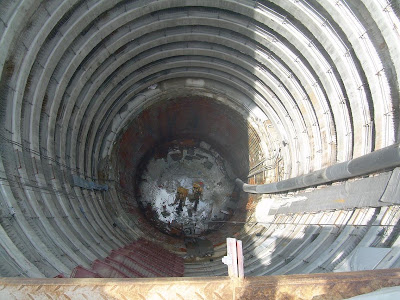 Incoming: One of the access shafts to the underground caverns built under a project managed by Singapore's JTC Corp.(Source: JTC Corp)
When the waste disposal process inevitably kicks it, it will demand high levels of deterrence as the nuclear waste is brought to disposal grounds overseas.
It will also demand a best-in-class information management apparatus. The PR officer who fretted over and worried over media reports from fallout from, say for example, red dye from an air force warplane, does not have what it takes to take command and demonstrate superior leadership for managing the consequences of a nuclear incident. If red dye made him sweat buckets, the implications of a nuclear incident - stolen fuel rods, safety and environmental issues etc - are clearly out of his league.
The Singaporean government is known to think long-term.
And there’s good reason to speculate on the reason behind the recent flurry of trial balloons on nuclear energy in the Singaporean media.
To be sure, the nuclear energy option is simply that – one of a number of energy alternatives on the table.
But you can bet that if the greenlight is given some day, things will move. Quickly indeed.
Visit the Home Team Convention from:
15 May 2010(Saturday) 1000 - 2000 hrs.
16 May 2010(Sunday) 1000 - 1800 hrs.
Location: SUNTEC Singapore International Convention & Exhibition Centre Exhibition Hall 603, Level 6.
The upcoming Home Team Convention (Suntec Convention Centre 15-16 May 2010) will show you how Singapore is protected today from baddies ranging from house robbers and illegal immigrants, to smugglers and terrorists.
To see how the Home Team will develop in future, you must look at recent articles in Singaporean newspapers and mull over the implications of the nuclear energy option.

Out of sight: Underground caverns tunnelled into granite metres beneath the surface represent ideal "safe houses" for high value facilities such as power plants and fuel storage. Some rock caverns are 27-metres high, which makes them as tall as a nine storey building. (Source: JTC Corp)
If Singapore goes nuclear, Home Team agencies will have to up their game substantially.
The concept-to-retirement process for nuclear energy will demand watertight security at every step of the journey. This starts from the time nuclear facilities are conceptualised to the process of disposing spent radioactive energy rods.
The Home Team – which is a catchall term which covers security agencies under Singapore’s Ministry of Home Affairs (MHA) – must scale up substantially to protect such nuclear facilities – if plans move into the execution stage.
At present, the Singapore Civil Defence Force (SCDF) goes on high alert whenever nuclear-powered vessels, such as United States Navy Nimitz-class aircraft carriers, dock in Singaporean waters. SCDF officers monitor the air quality around the vessel, round-the-clock in all weather conditions, and are trained, organized, equipped and supported to detect and mitigate radioactive contamination.
Using hand-held and vehicle mounted sensors like Sodium Iodide detectors, the SCDF can pick up and identify more than 500 types of radioisotopes. Its capabilities continue to evolve and adapt to Singapore's tropical weather, urban environment and wind patterns.
These operational deployments have been carried out faithfully for several years now, and to good effect.
Going forward, America’s Nuclear Emergency Support Team (NEST) serves as a best-in-class template worthy of study by Singaporean authorities.
Scientists and engineers familiar with the intricacies of harnessing the energy of the atom must be backstopped by a sharp-end of well-trained, heavily-armed security elements with high levels of initiative, team spirit and commitment to mission success.
Special forces elements within the Singapore Police Force contain just such high energy individuals and could form the high readiness core of the Home Team's version of NEST.
What’s needed is a framework to direct their resources to the complexities of nuclear energy security. Ideas need to be conceptualised and stress tested, and the Home Team funded with the resources to bring these plans to fruition.
In the case of nuclear energy, this could involved equipping the Police Coast Guard with ocean-going vessels to escort high value units carrying nuclear material on their journey to and from Singapore.
It will also involve 24/7 security at nuclear facilities on – more likely under – Singapore island.

When the waste disposal process inevitably kicks it, it will demand high levels of deterrence as the nuclear waste is brought to disposal grounds overseas.
It will also demand a best-in-class information management apparatus. The PR officer who fretted over and worried over media reports from fallout from, say for example, red dye from an air force warplane, does not have what it takes to take command and demonstrate superior leadership for managing the consequences of a nuclear incident. If red dye made him sweat buckets, the implications of a nuclear incident - stolen fuel rods, safety and environmental issues etc - are clearly out of his league.
The Singaporean government is known to think long-term.
And there’s good reason to speculate on the reason behind the recent flurry of trial balloons on nuclear energy in the Singaporean media.
To be sure, the nuclear energy option is simply that – one of a number of energy alternatives on the table.
But you can bet that if the greenlight is given some day, things will move. Quickly indeed.
Visit the Home Team Convention from:
15 May 2010(Saturday) 1000 - 2000 hrs.
16 May 2010(Sunday) 1000 - 1800 hrs.
Location: SUNTEC Singapore International Convention & Exhibition Centre Exhibition Hall 603, Level 6.
Saturday, May 1, 2010
Eyesore at sea

Singapore is the world's leading maker of jack-up and semi-submersible sea platforms, but you wouldn't have guessed it looking at a barge designed to give the Police eyes at sea.
The floating Command and Control (C2) centre is functional, yet fugly.
The C2 barge looks like something designed via committee - a blend of Police Coast Guard (PCG) specific operational requirements, translated into technical specifications, crunched down into a collection of design compromises to be built by the lowest bidder.
It looks like the progeny of awkward looking tin mining dredges once seen in Ipoh. Her inelegant yet functional block house harks back to Britain's HMP Weare floating prison - a design that only her architect could love.
At 80 metres in length and 30 metres wide, the 4,500-tonne floating platform gives new meaning to presence at sea. Mariners will have to notice her bulk because a collision at sea into the C2 barge will have dire consequences indeed. Her four-storey tall slab sides and sheer bulk will give her a radar echo rivalled only by super tankers or the biggest container vessels - this is no stealth platform.
When this monstrosity is moored off the Lion City's coastline, this littoral eyesore would give the PCG a floating base at sea. Two such platforms will be anchored off the coastline at locations that have not been disclosed.
If the artist's impression is to be believed, each C2 barge will have a four-storey accommodation/work block capped by what looks like a ship's mast festooned with communications aerials and quite possibly EO and radar(s).
And if it works as advertised, the C2 barge would give coast watchers a better feel of the goings-on at sea, day and night, whatever the weather. If something is amiss, the sea police will step off the floating platform and zip away towards trouble in one of their heavily-armed, high speed craft.
As the C2 barge will spend its time attracting barnacles in a strategic patch of sea, the PCG will cut down on their response time needed to reach that patch of sea. And the officers will have a place to stretch their sea legs during their rest periods - which is so essential for a force that provides maritime security 24/7.
One applauds the move to strengthen Singapore's maritime security.
The concept of having a mothership isn't new. Indeed, the United States Navy and US Army's armada of coastal vessels and modified landing craft that patrolled, defended and fought in the Mekong Delta during the Vietnam War as the Brown Water Navy employed a variety of motherships ranging from powered lighters to tank landing ships.
These provided the Brown Water Navy's patrol craft with a source of accommodation, repair space and a stable platform on which crews could relax and prepare for missions. Land lubbers often underestimate the enervating effects that the sea swell can have on the crews' physical and mental well-being, especially when they are deployed for protracted periods for operations on and from the sea.
One wonders if Singaporean rig builders such as SembCorp Marine and Keppel FELS were consulted. I am certain that better and perhaps more cost effective designs could have been tabled using offshoots of their better-selling commercial designs.
During the 1930s, a British designer called Guy Maunsell devised floating platforms to protect the Thames Estuary and Britain's eastern seaboard from air and maritime intruders. Many of these platforms resemble oil-drilling platforms, which Singapore excels in designing, fabricating, deploying and supporting on oilfields around the globe.
For a look at Maunsell's designs, click here.
From an operational security standpoint, the immovable dumb barge (dumb as in unpowered, not lacking in intellect) is a plump target that is out of place in the post-9/11 environment.
A semi-submersible or jack-up rig, on the other hand, would have better situational awareness as the C2 facilities have a better visual horizon - they being far higher above the sea surface.
PCG officers would be better protected and the structure could easily accommodate a helicopter platform for a Super Puma-type medum-lift helicopter. A rig is also more resistant to the vagarities of sea weather, these commercial designs having been designed to withstand terrific storms in open water miles from shore.
It may be too late to go back to the drawing board now. But one hopes that the Mark 2 incarnation of the floating C2 centre will have refinements that Guy Maunsell thought of decades ago.
At the very least, his 1930s era designs proved their worth during wartime service and looked way better that the PCG's C2 barge.
Subscribe to:
Posts (Atom)