Thursday, February 23, 2023

Change in Singapore Armed Forces Chief of Defence Force and Republic of Singapore Navy Chief of Navy


The 10 Singaporeans who led the Singapore Armed Forces (SAF) as Chief of Defence Force (CDF) gathered for a group photo a few years ago. Sadly, Lieutenant-General Ng Jui Ping (5th from left) has since passed on.

I know of at least three former SAF CDFs who have read Pukul Habis - because the retired generals (including General Winston Choo) kindly shared their feedback with me. Three other former Service chiefs - one from army, one from navy and one air force - have also read the book.

Am humbled and pleased that these generals made time to read the fictional war story. This is the first time three former SAF CDFs have commented directly on something I wrote.

As a writer, am also happy that they read the novel in the spirit in which it was written. As a Singaporean, I took great comfort in reading their feedback, which reinforced my enduring belief in the SAF's ability and readiness to do what's necessary in time of need.

Change in CDF and Chief of Navy
Yesterday's announcement that Rear-Admiral Aaron Beng, Chief of Navy (CNV) of the Republic of Singapore Navy, would take over from Lieutenant-General Melvyn Ong as CDF on 24 March this year saw some media highlight the CDF-designate's status as the first RSN officer for the SAF's apex position. And as part of the continuing process of leadership renewal in the SAF, RADM Sean Wat, RSN Fleet Commander, will assume the appointment of CNV on 10 March.

The SAF pays particular attention to keeping its people aware of how various arms come together to defend Singapore. For example, officer cadets train together during the Joint Term in the Officer Cadet School, which introduces officer cadets to the spectrum of operations that the SAF is capable of executing while forging professional bonds with future officers whom they will work with during their SAF career.

As officers rise through the ranks, they will participate in SAF war games of increasing size, scale and complexity. Such exposure adds to their appreciation of the SAF's spectrum of capabilities. So SAF senior leadership should be well-appraised of what the SAF can do in peacetime and during operations, with insights that go above and beyond what they learned in their own Service (i.e. army, navy, air force or defence intelligence service).

The appointment of Rear-Admiral Aaron Beng to the apex position in the SAF's leadership reflects MINDEF/SAF's confidence in the organisation's success in inculcating a Joint mindset amongst its officers. It is also a positive signal that capable officers, regardless of the colour of the uniform he or she wears, can shoot for the highest positions in the SAF.

Singapore has always been a maritime nation. RADM Beng's tenure as Chief of Defence Force will come at a time when MINDEF/SAF reflect on options for replacing key naval assets such as the Victory-class missile corvette and Endurance-class tank landing ships (LSTs), and introduces new and more capable Invincible-class submarines. As the LST replacement is expected to operate army and air force assets from her deck, RADM Beng's firsthand insights into the peculiarities of naval warfare will add value to a significant naval project that will serve as a springboard for sharpening RSN capabilities in delivering naval power, on and from the sea.

Friday, February 3, 2023

Tribute to Ms Alyce Pekors, US Navy Office, Singapore


Hi All,
I joined Instagram recently. Find me at @davidboeypix
I will use Instagram for mainly pictorial content. I set it up as a backup to Twitter, which I still value as a news aggregator.

Here is a tribute I posted on Instagram for Ms Alyce PekorsPukul Habis readers might recall seeing the name as one of the United States Navy characters in the chapter on Storm Watchers.
 

Visit to USS Carl Vinson, Man-of-war anchorage, Singapore harbour, 1988: Thanks to a family friend, Alyce Pekors, I got to visit United States Navy warships in my teens. This was long before I became a journalist. Seen here are my junior college mates with me (so skinny back then!) aboard USS Carl Vinson. Carrier air groups were much more diverse and colourful back in the 80s.

The visits arranged by Ms Pekors left a deep impression on me. This was the 80s, with no internet to learn about war machines and when reference books were expensive.

Ms Pekors cheerfully took my (landline) calls and never gave a hint of how busy she was (the days ahead of a port visit are very busy spells for the USN office). Whenever I asked if it would be possible to visit a big deck I saw offshore, she would reply: “Let me see what I can do”.

Like a doting aunt, she always delivered. Every. Single. Time. I would be told to show up at Clifford Pier. My name would be on the roster and off we went on the ferry to the Man-of-war Anchorage. I learned so much speaking to pilots and sailors on carriers, a battleship, amphibs and the then-new Aegis cruisers.

I never knew she was the longest serving American civil servant working in Singapore. I never knew how deeply respected she was by her coworkers. I only found out after she died in 2008 and her ashes were scattered in Sembawang Wharves - where her beloved US warships frequently docked.

I miss her so much. I honoured her memory by naming a USN character in my book, Pukul Habis - Total Wipeout (a story of war in Malaysia & Singapore) after dear Alyce Pekors. Gone but never forgotten by those who loved her
💔💐

Saturday, January 21, 2023

A message on Pukul Habis from David Boey


I am heartened to know that a small and growing number of readers have realised that there's more to the Pukul Habis story than first impressions might convey.

A number of people who know me well, or those who followed this blog over the years, asked: There must be a deeper meaning to what you've written?

Yes, indeed. There are Easter eggs and metaphors that people may find. I love Greek myths and legends, and especially like the approach taken by ancient authors who wrote stories with hidden meanings and messages.

Many have already found them on their own, without any hints or prompting from me. No, it's not the warnings against complacency or hubris. No, it's not the suggestions about Iron Dome.

Not all are obscure: I put some in plain sight - in the chapter titles... IYKYK

The Dedication to my daughters on page v is the first clue that there's something more. It reads: "May you one day learn what this book is all about."

I commend the perspicacity of readers who have gone above and beyond the obvious. Over time, as words gets around, more will learn and, hopefully, gain a deeper appreciation of what was intended.

To those celebrating the Lunar New Year, I send you my wishes for a happy, safe, healthy and bountiful year ahead for you and all your loved ones.

To everyone else: Have a safe and restful weekend!


11 March 2023 update: Books Kinokuniya in Singapore has stocked Pukul Habis. Please visit its main store in Ngee Ann City or Bugis Junction, or check the Kinokuniya online store here. The title should be available via Kinokuniya Malaysia soon. Please enquire with the KL store.

Related topic:
Ponder the imponderable? It's much harder than you think. Click here

Saturday, December 31, 2022

Ponder the imponderable? It’s much harder than you think...

I'm sure someone out there is convinced that our guys (American military forces) will never lose, or a carrier can't be sunk, but is that good storytelling? A hero only shines when they're up against a powerful, capable, even dangerous opponent... If the Good Guys win in every encounter, where's the conflict? That isn't a story - that's wish fulfillment. - Larry Bond, American war fiction author, co-authored Red Storm Rising with the late Tom Clancy, wargame designer and creator of the strategy games Harpoon and Command at Sea.

War fiction allows us to ponder the imponderable, such as nightmare scenarios that one hopes will never unfold in real life.

Ponder the imponderable? It’s much harder than you think, especially for a place like Singapore. 

Despite the city-state's high literacy rate and high standard of living, people here have not been exposed to war fiction about the Singapore Armed Forces (SAF) to the extent that people elsewhere - even in Malaysia - have experienced in film, literature and the creative arts. 

Consider these examples:

In the Malaysian movie, PASKAL, a Royal Malaysian Navy (RMN) officer goes rogue and joins a pirate gang. In the movie’s explosive finale, the officer fights against, and manages to kill, team members from the RMN special forces unit whose name inspired the movie. 

In the award-winning television series, Money Heist (La casa de papel), Spanish thieves outfox authorities in Madrid when they storm the Royal Mint of Spain and start printing their own money. The series was so popular it gave rise to a story of a more ambitious heist where the Bank of Spain was robbed of tonnes of gold. The gang gets away and gets the loot by outthinking and outrunning the Spanish police and military. Enjoyed the story where underdogs win? I did. 

The late Tom Clancy’s bestseller, Red Storm Rising, contains a number of battle scenes where US forces are beaten by their enemy. The US Navy aircraft carrier, USS Nimitz, is hit by Russian missiles after the carrier battle group’s sophisticated multi-layered defences fail to stop an attack by Russian bombers. Back in the 1980s, when the novel was published, the battle scene in the chapter, Dance of the Vampires, raised eyebrows as you had American authors writing about the sinking of American warships by the Soviet Union.


In war fiction, the Good Guys do not always win.

Robert Harris' novel, Fatherland, explores a world where the Nazis win and rule Europe after the Second World War. The book's cover asks the provocative question: What if Hitler had won the war? It is a bold plot, written by a British author, of a dystopian world. 

Fatherland is just one example of historical fiction that builds upon the theme of a German victory after the Second World War. Another novel is Philip K. Dick's alternative history, The Man in the High Castle, whose storyline advances the idea of an Axis victory after the Second World War, with America partitioned by the war's victors: Germany and Japan.

Just imagine if Pukul Habis ended with a chapter where the SAF is destroyed and the Jalur Gemilang (Malaysian flag) was raised at the Padang. Too bold for your comfort? I thought so too...

On the other hand, if Pukul Habis was written in a way that trumpeted a swift and decisive SAF victory, this storyline would probably have earned five-star appeal with many readers - at least those from Singapore. But had the book taken that route (Note: Just to be clear for those who have yet to read the story, it was not written in this way), how do you think Malaysians would have responded?

As I have noted before, a self-congratulatory novel would have been much simpler to write. Spicing it up with secret-edge capabilities would probably have given some people a wargasm (assuming the security agencies didn't get provoked first, which was a risk I did not want to chance). Never forget: We live in a place where even plastic model makers are afraid of painting models of certain weapons like MBTs and missile systems green for fear of triggering the security agencies. 

But pondering the impossible, asking what might happen if plans somehow DO NOT survive first contact in a fictional world is something that I have thought about on many occasions. Shouldn't the fictional world afford us some latitude in thinking the unimaginable?

Since the novel was published a month ago, I have received feedback from professionals in Singapore who are involved with defence matters. This includes several face to face meetings (which I enjoyed and found intellectually stimulating) that tell me that the novel has made such individuals think about certain circumstances and issues mentioned in the book.

So it gives me some confidence that suspicions abroad that Singaporeans are thin-skinned, hyper sensitive, soft and casualty-averse city boys, intolerant of any world view that does not conform to their own, is unfounded - for the moment. One would hope such confidence isn't misplaced. But time will tell as more and more readers share their thoughts.

I have read all the feedback on Amazon. I have also kept screenshots of the feedback posted, especially the negative ones for future reference. Reading such feedback and hearing your thoughts on the story whenever we get a chance to meet has been a good learning experience. 

Indeed, my first principle when writing this story is that no book is beyond reproach.

I have to share, however, that what I find more worrisome than negative feedback is the mentality that the story may have been less objectionable if there was some sort of parity in the loss exchange ratio, a kind of balance with battle losses sustained by both sides in more or less equal measure, a storyline where the hurt that both sides endure rests in a kind of equilibrium.

My study of war at school, all my readings on warfare have made me acknowledge that the business of war is brutal, messy and unpredictable. 

When the Royal Navy battleship, HMS Prince of Wales, and battlecruiser, HMS Repulse, were sunk off Kuantan in December 1941, the loss ratio was hardly a balanced one. Two major Royal Navy surface units sunk, more than 800 British sailors killed in action in exchange for three Japanese bombers shot down (one more crashed on landing). Where is the parity, the balance and the sense that all is fair in war?

The Fall of Singapore saw the Japanese capture Fortress Singapore, even when outnumbered 3:1 by British Imperial forces. These are real battle statistics - not something made up in a hyperactive mind and typed out as a story.

Even Tom Clancy's Red Storm Rising made NATO's defence of western Europe a close run thing.

The book's chapter, A Walk in the Woods, relates the conversation between NATO Supreme Commander, General Robinson, and Russian General Alekseyev who believed the USSR would have been dictating terms if Warsaw Pact forces smashed "three or four more of your convoys". Make that one or two convoys, Robinson reminded himself. It was that close.

While some individuals in Singapore may chafe at the descriptions of SAF losses in Pukul Habis, there may well be elements in Malaysia who do not take kindly to descriptions of a two division SAF breakout after a weakly contested crossing of the Johor Strait, followed by a march north about 100 km in three days. An incompetent SAF would fail to achieve that sort of battle performance, and I hope the hat tip was not so subtle and too implied for readers to pick up.

I am fairly certain reactions to the novel are now being monitored by foreign military professionals whose job is to make sense of Singapore's commitment to defence and resilience.

In mature societies and in armed forces prepared to ponder the impossible, war fiction has served as a catalyst for discussions on unthinkable scenarios. 

War fiction has also acted as a handy platform for raising situations that the directing staff for war games may find difficult articulating in their situation injects. Through such discourse, organisations improve through clear and thoughtful realisation that should the worst happen, their organisations would have the mindset and tenacity to adapt and adjust to whatever the fog of war throws at them. You don't get there by desperately clinging to hopium. 

Larry Bond, the American author who partnered the late Tom Clancy years ago to write Red Storm Rising, shared with me how the United States military reacted to their scenarios which described losses among US forces, including the NATO-Warsaw Pact clashes that nearly ended catastrophically for NATO forces, as Gen Robinson himself conceded in the story.  

"I've never had a problem or received any negative feedback about showing US forces losing a fight," said Larry. 
"I'm sure someone out there is convinced that our guys will never lose, or a carrier can't be sunk, but is that good storytelling? A hero only shines when they're up against a powerful, capable, even dangerous opponent... If the Good Guys win in every encounter, where's the conflict? That isn't a story - that's wish fulfillment."

Related posts:
Why Pukul Habis was not written from a Singaporean perspective. Click here
Pukul Habis: Author's Note. Click here
Pukul Habis: Full text of Prologue. Click here
Why does the English language novel, Pukul Habis, have a Malay title? Click here

Pukul Habis: Total Wipeout
11 March 2023 update: Books Kinokuniya in Singapore has stocked Pukul Habis. Please visit its main store in Ngee Ann City or Bugis Junction, or check the Kinokuniya online store here. The title should be available via Kinokuniya Malaysia soon. Please enquire with the KL store.
 
For readers elsewhere, please check the Amazon sites that serve your location. "Look Inside" function on some sites shows sample pages.

Singapore: https://bit.ly/3XJzInH

Australia: https://amzn.to/3ViaX0i

United Kingdom: https://amzn.to/3EZ6clA Look Inside

USA: https://amzn.to/3Ui3Eo1 Look Inside. When ordering from Singapore, please click on the "Shipping to Singapore?" button. Ignore the "Temporarily out of stock" notice on the Amazon.com page.

Monday, December 26, 2022

Remembering the 2004 Boxing Day Indian Ocean earthquake & tsunami


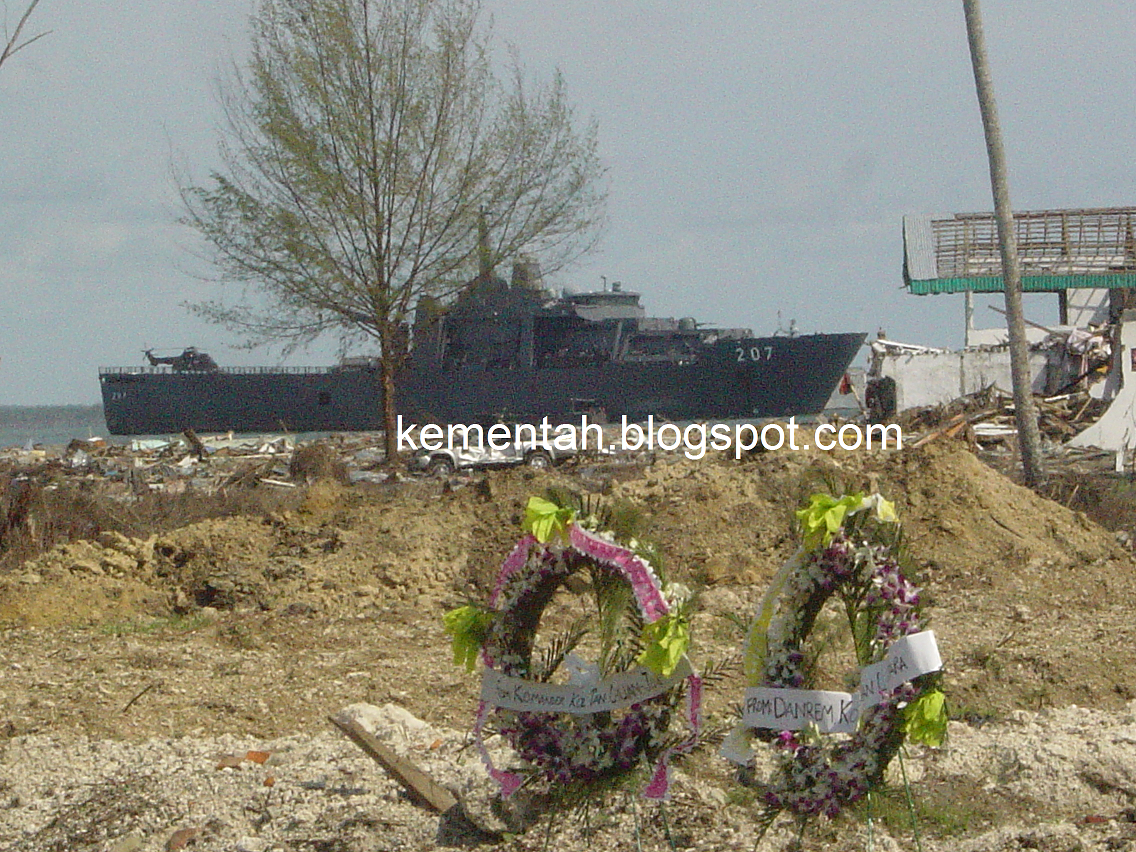
The Republic of Singapore Navy tank landing ship (LST), RSS Endurance, seen from the mass grave in Meulaboh, Sumatra. I joined the Singapore Armed Forces (SAF) Operations Flying Eagle team and the TNI for a joint memorial ceremony on the last day of the SAF HADR mission in the coastal town. It was a very moving ceremony. At one point during the operation, the LSTs were designated as "helicopter landing platforms". This non-standard nomenclature arose because the SAF wanted to indicate to United Nations agencies coordinating international relief efforts that the LSTs were capable of embarking helicopters from their decks.
Singapore Army commanders and officers from RSS Endurance salute Meulaboh as the LST raised anchor and set course for Singapore on the last day of Operation Flying Eagle. The SAF sent three Endurance-class LSTs to Meulaboh. A fourth ship of that class was deployed for operations in the Persian Gulf during that same operational window. 

For me, Boxing Day will forever be remembered for the Indian Ocean earthquake and tsunami that struck countries like Indonesia, Malaysia, Thailand, Sri Lanka on the morning of 26 December 2004.

I would imagine that those of us who were sent for humanitarian assistance and disaster relief (HADR) missions to countries affected by what became known as the Boxing Day tsunami will never forget that experience.

The Singapore Armed Forces HADR mission, codenamed Operation Flying Eagle, marked my longest embed with the SAF - about 3.5 weeks with the Ops Flying Eagle team.

Today marks the 18th year since that natural disaster. Will spend a moment of quiet reflection in memory of those who died during the 2004 calamity, and pray that the survivors are coping well.


Here is a selection of pictures from my album. I have always wondered where the kids who played in the downwash of the departing helicopters are now, and how they are doing. Must be all grown up by now.

I wrote a book on the SAF's tsunami relief mission, titled Reaching Out: Operation Flying Eagle. Download your copy of the book here: https://bit.ly/3juX94p

Monday, December 19, 2022

We're on Facebook: SenangdiriHQ


I have a new Facebook page with the username, SenangdiriHQ, which all of you are welcome to visit. 

I will use Facebook to update you with spoiler-free, behind-the-scenes stories that tell more about how I wrote my first novel, Pukul Habis, and the sequel planned. Please follow if you are keen to learn more, or if you just want to stay in touch.

I started the Facebook page recently in case Twitter goes offline, or in case Twitter proves untenable under current management practices. I heard that not all of you are on that social channel, hence the (belated?) decision to join Facebook. 

For those who got the book on Amazon, please do consider leaving a review on that site. I am trying to convince publishers that there is interest for war fiction set in this part of the world. They’re not convinced anyone would want to read about Malaysia, Singapore as compared to the usual menu of war stories set in places like Europe, the Middle East, the Korean Peninsula etc. Malay peninsula “too niche”. Much appreciate your time sharing feedback 🙏🏼


For readers in 🇲🇾Malaysia: Do check if there's a Free Shipping option for orders above S$40, as indicated on the Amazon Singapore page: https://bit.ly/3XJzInH 

For readers in 🇸🇬Singapore: Do remember that you can get the book from Amazon Singapore with Free Shipping for orders above S$40, or with Amazon Prime. I think you can try this service on a trial basis too, if you're not already using it.

Happy holidays!

If you are in Malaysia, get the book from Books Kinokuniya's store at Suria KLCC. Kino will also mail it to any location in Malaysia. Please click here for details.

Books Kinokuniya Singapore has stocked Pukul Habis (ISBN 9789811861499). Please visit its main store in Ngee Ann City or Bugis Junction, or check the Kinokuniya online store here.

For readers elsewhere, please check the Amazon sites that serve your location. "Look Inside" function on some sites shows sample pages.

Singapore: https://bit.ly/3XJzInH

Australia: https://amzn.to/3ViaX0i

United Kingdom: https://amzn.to/3EZ6clA Look Inside

USA: https://amzn.to/3Ui3Eo1 Look Inside. When ordering from Singapore, please click on the "Shipping to Singapore?" button. Ignore the "Temporarily out of stock" notice on the Amazon.com page.

Wednesday, December 14, 2022

6 things to note about the RSN Invincible-class submarines, Impeccable and Illustrious

On Tuesday (13 December 2022), Singapore Prime Minister (PM) Lee Hsien Loong officiated at the launch ceremony for the Republic of Singapore Navy (RSN)'s second and third Type 218SG Invincible-class submarines, Impeccable and Illustrious, at thyssenkrupp Marine Systems (tkMS) shipyard in Kiel, Germany.

The ceremony marked a rare occasion when observers could take a close look at the 70-metre long, 2,000-ton boats, which look set to be the largest and most advanced diesel-electric, AIP-capable hunter-killer submarines in Southeast Asia.

The Type 218SGs, the largest submarines designed and built by the German yard, had been photographed on many occasions while on sea trials. But the images and videos were all taken from a distance. 

The launch ceremony for the name ship of the class, Invincible, in February 2019, had the boat hoisted out of the water, with her upper hull and deck features not visible to guests.

While the sight of two submarines side by side was visually appealing, there's a lot left unsaid about what these boats can do. 

Here are six things that caught our attention (kementah.blogspot.com):


Number 1: Hull features
The decorative, wrap-around bunting that was painstakingly tied by hand made one think about why so much effort went into dressing the boat. Naval observers would prefer a clean, naked hull with all protuberances visible. It was interesting to note that the level at which the bunting was secured could correspond to the parts of the boat's hull where one would normally find tubes for torpedo countermeasures.

Number 2: Screw
Just as Type 219SG's hull was on show - yet not shown fully thanks to the bunting - neither was the boat's screw. The blade count and shape of blades are normally points of interest for ship watchers. At Tuesday's ceremony, the screws for both boats were not visible as the water level in the dock kept their design features out of sight.

Number 3: Combat management system
Seventy metres of steel shark is a lot to behold. What you do not see is the heart of the fighting machine - the combat management system (CMS) that makes the boat a man-of-war. If Singapore's Defence Science & Technology Agency (DSTA), the national authority on weapon systems, takes a leaf from the Formidable-class stealth frigate project, then the software for the CMS is likely to be bespoke. 

This milestone is significant. The Formidable-class CMS benefitted from years of experience developing and fielding similar systems for the Republic of Singapore Air Force (RSAF). The frigate's abovewater sensor suite, which tracks surface and aerial contacts, is essentially a mobile and seaborne version of radars and other sensors used by the RSAF.

A submarine's CMS suite, however, demands rather different skillsets. It is more challenging than applying the know-how needed to display and interprete data from a ground-based radar to a shipborne radar. 

The expertise needed to master underwater sensors is in a class of its own. These include sensors like active and passive sonar technology. Operating conditions beneath the waves are also different and engineers must develop an appreciation of water conditions - temperature, salinity, prevailing currents and tidal flows - and things like the seabed profile and acoustic conditions in the area of operations for the CMS to make sense of what is around the submarine. Otherwise, the sub fights blind.

So watch closely for any signs of the degree of local involvement in the submarine CMS, as this would telegraph a noteworthy step up in Singapore's defence engineering expertise.

Number 4: Mast
In some navies, every mast and device on the conning tower is raised to demonstrate the sub's mast-mounted sensor suite. One guesses that the time isn't quite right for the Invicible-class. But take note of the mast configuration when they do.

Number 5: Number of bunks
It was interesting to read that all 28 crew members on the Type 218SG would have their own bunks. On subs, the bunks are usually shared by crew members on different watches - a practice known as hot bunking - in order to save space aboard the sub. If you read between the lines, this could mean that the Type 218SG could, theoretically, embark up to 14 personnel who are not part of the boat's crew. This assumes the boat practices hot bunking, with the empty sleeping spaces allowing more warm bodies aboard. Food would be an operational limitation, but with dry rations and ample space on the boat, will not be a weighty hinderance to ops planning. Rather interesting fictional scenarios one could write about with half a platoon of special forces types onboard for insertion by sub.


Number 6: Operational tempo
Four boats on call suggest that the RSN could maintain a high operational tempo with the Invincible-class boats, once all are commissioned into active service around the end of the decade. Four boats means you could have one for training, one undergoing maintenance or refit, with a balance of two for operational taskings.

In summary, interesting times ahead for the RSN's unerwater warfare community.


If you like submarines, do note that my new book, Pukul Habis - Total Wipeout, has several chapters on the exploits of the Royal Malaysian Navy submarine, KD Tunku Abdul Rahman, as the boat embarks on her first war patrol with Exocets, Black Shark torpedoes and the boat's SUBTICS combat management system.

Pukul Habis: Total Wipeout: Now available from Amazon sites that serve your location. "Look Inside" function on some sites shows sample pages.

Singapore: https://bit.ly/3XJzInH

Australia: https://amzn.to/3ViaX0i

Canada: https://amzn.to/3VkjqQP Look Inside

France: https://amzn.to/3uenBS5 Look Inside

Germany: https://amzn.to/3XLcJc0 Look Inside

Japan: https://amzn.to/3gS2Loz Look Inside

Spain: https://amzn.to/3OSfi7S

Sweden: https://bit.ly/3GWq7UI

United Kingdom: https://amzn.to/3EZ6clA Look Inside

USA: https://amzn.to/3Ui3Eo1 Look Inside