Thursday, April 23, 2020

Circuit breaker Day 17 pix: Decommissioned Republic of Singapore Navy LSTs

Decommissioned County-class tank landing ships were moored at the Republic of Singapore Navy's Changi Naval Base (CNB). RSS Endurance L201 is seen here tied up to seaward of RSS Excellence L202, the latter LST identifiable by her large deck crane.

It should be obvious by now that I was quite fond of the old RSN LSTs which United States Navy sailors nicknamed "large slow targets" during WW2. Yes, they were old. Yes, their flat bottom gave them a lively ride even in moderate seas. Their heads discharged waste straight to the sea. But I think the old LSTs had character and I never got tired of looking at them.

Thanks to the LST crews, the SAF never faced the problem of a foreign nation impounding our armoured vehicles. The old LSTs carried interesting cargo too on some of their voyages.... usually unloaded at night near Bedok Jetty (Tuas Naval Base wasn't built back then).

This picture was taken on 21 May 2004 when then-Prime Minister Goh Chok Tong officially opened CNB, the RSN's newest naval base.

The next day's newspaper left bittersweet memories because I got two Page 1 bylines - which is quite rare for a journalist to achieve. The opening of CNB was a happy story. The death of Republic of Singapore Air Force F-16 pilot Lieutenant Brandon "Chip" Loo was the other Page 1 story. For me, it was never easy writing about Singapore Armed Forces training deaths : (

Wednesday, April 22, 2020

Circuit breaker Day 16 pix: Republic of Singapore Navy display at the National Day Carnival 21

Vital Force: This single picture shows you how small the Republic of Singapore Navy (RSN) was in August 1986. The 11 fast craft seen here off Bedok Jetty made up just under half of the RSN's active strength of 24 frontline fast craft. With about eight hulls (30%) in refit or under maintenance at any one time, this left a meagre force for the seaward defence of a maritime nation that was (and still is) heavily dependent on seaborne trade. The Sea Wolf-class Missile Gunboats (Lürssen TNC45) with a main armament of five Gabriel anti-ship missiles (below) were then the pride of the Navy.

The Republic of Singapore Navy (RSN) turned up in strength at the 1986 National Day Carnival held near the Bedok Jetty to mark Singapore's 21st year of independence. 

The Navy anchored more than half of its active strength of 24 fast craft off East Coast Park in a show of force that was then unprecedented. Fourteen RSN fast craft took part: Six Coastal Patrol Craft (drawn from two squadrons of 12 CPCs), four Missile Gunboats (out of six), four Patrol Craft (out of six). The tank landing ship, RSS Excellence L202, beached itself near the Bedok Jetty as an exhibition site.

For Singaporeans who never saw their Navy up close, the double lines of fast craft anchored close to shore made an impressive sight. Visitors were brought out to sea on Ramp Powered Lighters (RPLs) for a closer look at the warships as RSN officers gave them a guided tour of the warships using a microphone.

Looking back, the RSN was at a pivotal moment in 1986. A new type of fast missile craft called Missile Corvettes had been ordered under Project S. Political office holders were now enlightened to the importance of the Navy and were prepared to give the RSN renewed emphasis. 

Every ship you see here has been replaced in a new, invigorated Navy that builds on the efforts and sacrifices of hardworking RSN pioneers from a different era. We honour them all.

 Swift-class CPCs backlit by the morning sun.
A 20mm Oerlikon, aimed by a spiderweb sight and Mark1 eyeball. The gun was fitted on the CPCs and Vosper Patrol Craft "A" and "B" classes.
The 1986 National Day Carnival marked the first (and only?) time the RSN displayed a County-class LST in the up-gunned configuration. RSS Excellence had two Bofors 40mm L/70 guns and two Oerlikon 20mm cannon added on deck to complement its usual armament of a single 40mm Bofors on the bow plus about six pintle-mounted 12.7mm MGs around the ship (two bow, two side of bridge, two at the stern). Note how the low tide has exposed the steep beach gradient. I took this shot early in the morning after walking to the Bedok Jetty from home and returned in the afternoon to queue up to visit the LST. 

After many trips stalking the LSTs at Bedok Jetty, my visit to Excellence was my first time aboard a tank landing ship. The trip was awesome and the RSN ambassadors did a splendid job hosting the public. Thank you for forging such a positive first impression which I fondly remember more than 30 years on. 

NOTE: So Singapore has extended the circuit breaker for four more weeks till 1 June 2020. I've no problem sustaining the daily photos till then. If there's something in particular you want to see, please drop me a line in the comments or email. Only unclassified platforms and systems please!  :-)

Tuesday, April 21, 2020

Circuit Breaker Day 15 pix: Republic of Singapore Navy Tank Landing Ships LSTs at Bedok Jetty

Announcements of Bedok Jetty exercises drew me to the place like a clarion call during my teen years in the 1980s. I loved seeing the LSTs beach themselves with their enormous bow doors wide open. RSS Excellence L202 (above) and Resolution L204 (below) seen at the landing site a few hundred metres east of the jetty on separate beaching exercises. Sorry for the poor picture quality. The print pictures, which were taken when I was a teen, have faded with age and I'm not a good photographer to begin with.  


One activity I enjoyed during my teenage years in the 1980s was tracking Singapore Armed Forces (SAF) exercises at Bedok Jetty, which was about 3km from my home. I'd watched the Sunday evening television news for the weekly announcement of SAF exercises to see if there was anything scheduled to take place at Bedok Jetty. I'd get quite excited whenever the public was advised that car parks F1 and F2 near the Bedok Jetty would be closed as that would mean the SAF would be there.

If it was a school holiday and if I'd cleared my homework during a school week, I would walk or cycle to the jetty to see what was happening. I saw Republic of Singapore Navy (RSN) Landing Ship Tanks (LSTs) beached there on several occasions. Sentries usually set up cordons east and west of the jetty at bridges that led over canals to prevent passersby from getting too close. But if you were patient, sometimes you'd luck out when the sentries removed the white tape while the LST was STILL ashore. This usually took place in the late afternoon. One suspects the sentries opened the cycling track and foot path as they wanted to return to camp.

Over the years, I saw all five active LSTs beached there or offshore. A sixth LST was mothballed off the Serapong golf course on Sentosa, opposite Pulau Brani which was then the RSN's main naval base.

Every tank landing ship was different. I liked RSS Endurance L201 the most because she was the only LST with three gun tubs on the bow (only one gun tub had a Bofors 40mm L/70, the rest were vacant). Excellence L202 was unique as she had a helideck at her stern while Intrepid L203 had an enlarged blockhouse superstructure that gave the LST a distinctive silhouette. Resolution L204 was little changed from her 1970s appearance while Persistence L205 also had a renovated bridge and was said to be a command ship. I remember making a trip to the old National Library to photocopy the Singapore entry for Jane's Fighting Ships for information on the RSN. Singapore's navy was (and still is) small compared to other naval forces and it did not take long to get yourself familiar with the Missile Gunboats (MGBs), Patrol Craft "A" and "B" class, Coastal Patrol Craft (CPCs), the LSTs and Ramp Powered Lighters (RPLs) because that was all Singapore had back then. 

Here we see Excellence L202 beached at Bedok Jetty one lazy weekday afternoon. Sadly I didn't date the pictures at the time but this must've been in the late 1980s. Note the white tape draped over comms cord in the picture below to form a token cordon, which yours truly happily breached once the ramp was up, the sentries had disappeared and it was clear the LST was about to sail away.

The LSTs were then the RSN's largest warships. It was quite a sight seeing 100 metres of LST going astern with the help of a LCVP and a stern anchor (the ship reeled in the stern anchor chain to pull the bow off the beach). The ship's PA would cackle with some order, which could not be heard clearly from shore. Door hinges would creak as the ramp was raised and clam shell doors shut slowly. A puff of smoke from the diesel exhaust vents on the side of the hull showed the engine room was ready to move slow astern. Muddy eddies would swirl round the bow as the LST pulled off the sandy bottom, gaining speed once her flat bottom moved into deeper water as the hardworking LCVP acted like a tugboat to guide the mothership astern safely.

In the fading evening night, Excellence would point her bow to the sea lanes in the Singapore Strait and cruise away silently, her job done at the Bedok Jetty.
Some crew from RSS Excellence crew (in civvie) appear to be booking in from shore. I crossed the cordon (white tape in foreground) once the ramp was up and the LST was about to pull itself off the beach.


This particular beaching exercise seemed to be supported by a Coastal Patrol Craft. All I had was an autofocus camera with minimal zoom so the name of that CPC is lost to history. Note the LCVP (above the right dinghy) returning to the LST.

Monday, April 20, 2020

Post on County-class LSTs


Hi folks,
I've some blog posts scheduled automatically for future release and the one on LSTs misfired and was posted before its due date. I recalled it to keep to the sequence of the daily "circuit breaker" pictures, which are posted at 12:01AM daily from now till 4 May 2020.

We're two weeks into the CB period. Hope you are keeping well as can be, considering the circumstances. Don't let cabin fever get you down.

My best wishes to you all,

db

Circuit breaker Day 14 pix: HIMARS rocket artillery


When is the next time you can safely pose for a group photo like this? 

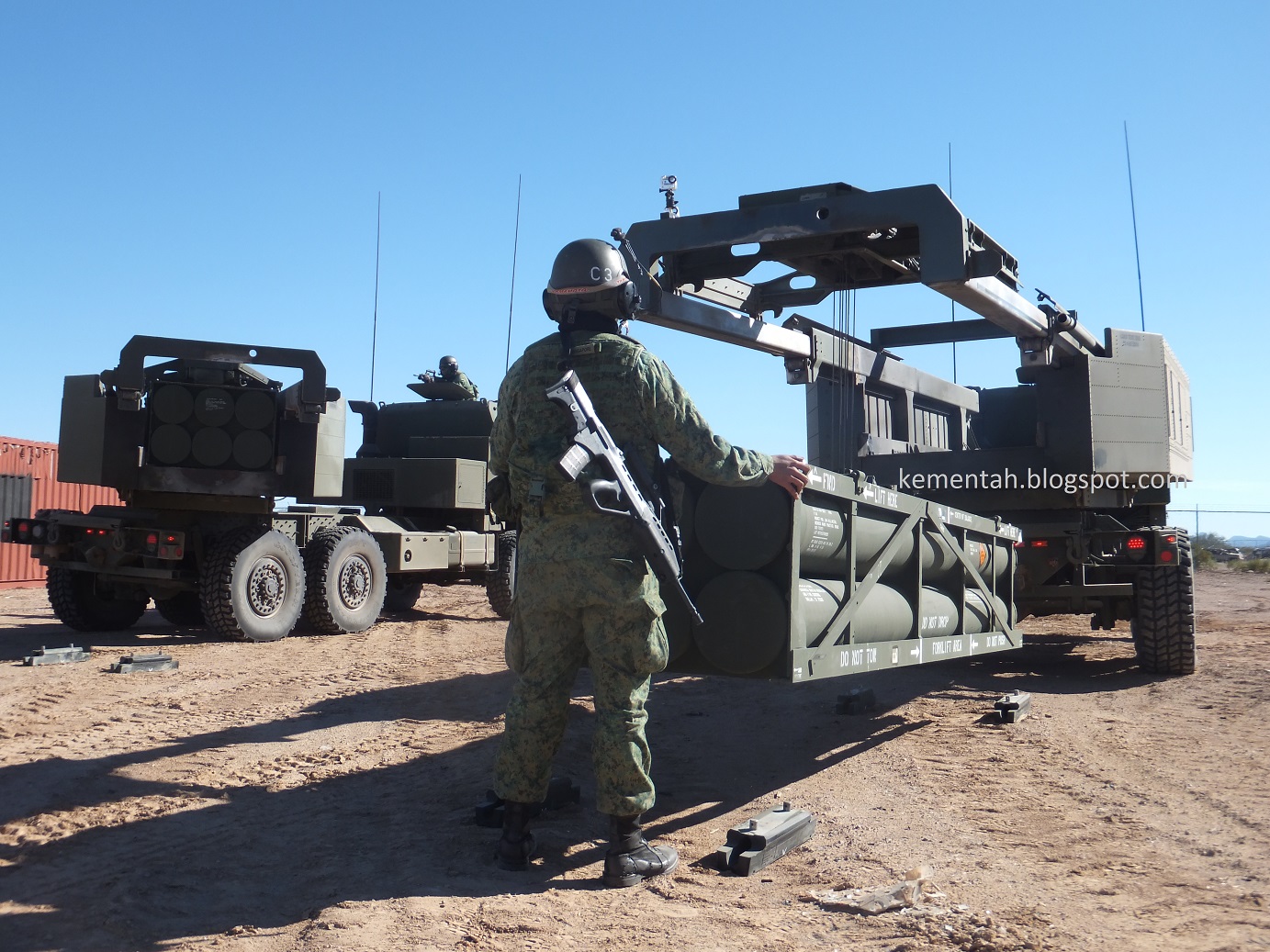
Had a great time in Arizona in December 2013 at Exercise Forging Saber (XFS) with Bravo Battery, 23rd Battalion, Singapore Artillery (23 SA). Gunners from the battery showed how they loaded and fired a High Mobility Artillery Rocket System (HIMARS) during the air-land combined live-fire exercise, which was held at the Barry M. Goldwater Air Force Range.

You can't tell from the picture but it was near freezing when B Bty 23 SA posed for that picture after the night firing segment of XFS.


HIMARS has its own crane to winch and load a rocket pod. The Singapore Artillery uses the Guided MLRS rocket (GMLRS, pronounced as "gimleers"). GMLRS has a 200-pound warhead and earned the nickname "70km sniper" when used in combat fire missions by foreign armies. 
HIMARS rockets fired during XFS were blunt-nose training rounds with reduced lethal effects compared to warshot. The fire missions validated the Singapore Armed Forces' sensor-to-shooter processes against a variety of fixed and moving targets.

Sunday, April 19, 2020

Circuit breaker Day 13 pix: Next Fighter Replacement Programme Rafale & Eurofighter Typhoon

Test cell: An unpainted Rafale having its engines tested in a hush house. The Rafale lost out to Boeing's F-15 Strike Eagle in the final evaluation of Singapore's Next Fighter Replacement Programme that sought to find a replacement for the A-4 Skyhawk.

As a journalist, I covered Singapore's Next Fighter Replacement Programme (NFRP) when it started in 1998 with six candidates - Boeing F-15E Strike Eagle & F-18E/F Super Hornet, Dassault Aviation Rafale, Eurofighter Typhoon, Lockheed Martin F-16E/F (or Block 60) and Sukhoi Su-30 - and wrote the NFRP's concluding news release seven years later when the F-15 was picked as the winner.

Six candidates became three after Singapore's Ministry of Defence and Republic of Singapore Air Force (RSAF) downselected the F-15 together with the two European contenders, the Rafale and Typhoon. Then it was F-15 versus Rafale in 2005. In September 2005, Boeing F-15T was declared winner of the seven year long evaluation (the designation was later changed to F-15SG).

I visited the aircraft production lines at Boeing, BAE Systems (which was testing the then-new Typhoon) and Dassault Aviation. Sitting through separate briefings by rival aircraft makers was an interesting experience. The opportunity to see three different production lines was also an eye-opener as it allowed one to compare different approaches to aircraft design and manufacturing philosophy, combat roles, and life cycle support.

Along the way, one can piece together the strengths and weaknesses of the NFRP candidates based on tidbits of information shared by rival campaigns during on-the-record briefings and informally.

When NFRP became a two horse race, I had hoped Singapore would pick the Rafale. A diversified fleet of frontline fast jets would have immunised the RSAF against issues that might arise from situations when dealing with a sole source supplier. Some Arab air forces operate a diversified fleet successfully with American-made F-16s or F-15s flying alongside frontline fighters from elsewhere. Looking at the Rafale's combat record, the warplane is no slouch in combat and would have been a worthy A-4 successor.

The Eurofighter Typhoon was another promising candidate. Alas, the platform was too new and, in my opinion, the lack of maturity counted against it. BAE Systems fronted the marketing campaign for the Eurofighter consortium. Their marketing and engineering teams did their best. But in the end, Typhoon's capabilities were based largely on promises of what was to come rather than what you could see. In hindsight, Typhoon achieved or exceeded every campaign promise. From a cold start, few platforms can beat Typhoon in QRA and its combat record has validated every claim BAE made.

It's interesting to think about what capabilities Rafale and Typhoon might have brought to the RSAF had either platform been selected. Even today, I track the combat experience of the NFRP candidates out of personal interest. I would compare what I read or see in videos with what was shared by the respective manufacturers more than 15 years ago to see what has changed since then.


Year 2000: I met the Rafale at Dassault's flight test facility in Istres (below) and also at Dassault's aircraft plant near Paris where heaps of Mirages were being overhauled.

Year 2002: With BAE Systems and an early model Typhoon.

Saturday, April 18, 2020

Circuit breaker Day 12 pix: Leclerc MBT and tank factory visit

Special demo of the Leclerc MBT for visitors from Singapore. Yours truly holding the SG flag.

In the late 1990s, French weapons maker GIAT Industries tried to sell the Leclerc main battle tank to Singapore.

In May 1998, I flew to France to see the GIAT Industries tank factory in Roanne, in central France. The Roanne factory, which made the Leclerc MBT, was the first tank manufacturing facility that I ever visited. The factory had added significance for me because the Singapore Army's first light tank, the AMX-13, was made at the same factory in the 1950s. 

The French were excellent hosts. There was a briefing on the history of Roanne and a site walk that showed how they made the Leclerc, starting from steel plates all the way to the paint shop for newly-built tanks. The visit ended with a mobility demo by a Leclerc MBT plus a chance to speak to the three-man tank crew (driver, gunner and vehicle commander). Knowing my interest in the AMX-13, GIAT staff pointed out the buildings where the AMX-series was made. Many of these buildings had stayed virtually unchanged over the decades, with only internal machinery and jigs changed for different armoured vehicles.

The second stop in the itinerary was a visit to GIAT's artillery factory 220km away near the city of Bourges. The Bourges arsenal was special as this factory made the LG1 105mm light guns that GIAT supplied to the Singapore Artillery in the early 1990s. GIAT also showed their GCT 155mm self-propelled gun and brought me to an amazing museum dedicated to the study and documentation of artillery shells, rockets and fuzes. It was claimed that the museum had one example of virtually all Western-made shells dating back to the First World War. Looking at their extensive exhibits, there was no reason to doubt that claim. 

GIAT Industries Roanne tank factory

The GIAT Industries tank factory in Roanne was the place that made the AMX-13 light tanks used by the Singapore Army. Factory buildings stayed virtually unchanged since the AMX-series was made there.

GIAT Industries, Bourges

The GIAT artillery shell museum in the Bourges arsenal. Note the mine-clearing line charge between the two green pillars on the right. The museum has a heavy emphasis on artillery as the Bourges arsenal has traditionally been the place that makes tube artillery for the French Army.